
Everyone says "audit-ready." Almost nobody is.
The term has become a checkbox in pitch decks and product pages. But when a verification body actually requests the evidence package for a first crediting period, the gap between the claim and the reality becomes painfully visible.
Audit-readiness is not a feature. It is a property of how data was collected, structured, and connected from the first day of the project.
What an auditor actually looks for
A Validation/Verification Body (VVB) evaluating an ARR project does not want a polished dashboard. They want traceable evidence that answers specific questions:
Baseline validity. What was the carbon stock before intervention? How was it measured? Were field plots established at representative locations?
Additionality documentation. What was the land use history? Is there evidence that the area would not have regenerated naturally without intervention?
Monitoring protocol. How is sequestration being measured post-planting? What is the sampling design? Are permanent monitoring plots established?
Decision traceability. Why was this planting method chosen for this zone? What diagnostic data informed the species selection?
Consistency between plan and execution. Does what was planted match what was planned? If deviations occurred, are they documented with reasons?
"The auditor's question is never 'show me your results.' It is 'show me the chain - from the diagnostic that identified the problem, to the design that proposed the solution, to the execution that implemented it, to the monitoring that measured what happened.' If any link is missing, the whole chain is questionable." - Hugo Asselin, Co-founder and CTO, MORFO
The most common failures
The errors that delay or derail verification are rarely about bad data. They are about disconnected data.
Reconstructed evidence. Data that was not collected at the time of the decision but was assembled after the fact to satisfy the auditor.
Unstructured data. Soil analysis results in PDF reports. Drone orthophotos on a shared drive. Progress tracking in a spreadsheet. All the data exists, but assembling it into a coherent evidence package takes weeks.
Undocumented decisions. The restoration plan says "mechanized seeding" for zone Z1-N. But why? What diagnostic data led to that choice?
Inconsistent timestamps. A soil analysis dated March 2025 informing a planting prescription executed in November 2026. Is the soil data still valid after 20 months?
What traceable means in practice
Traceability is not transparency. Transparency means making data visible. Traceability means connecting every data point to its source, method, date, and the decision it informed.
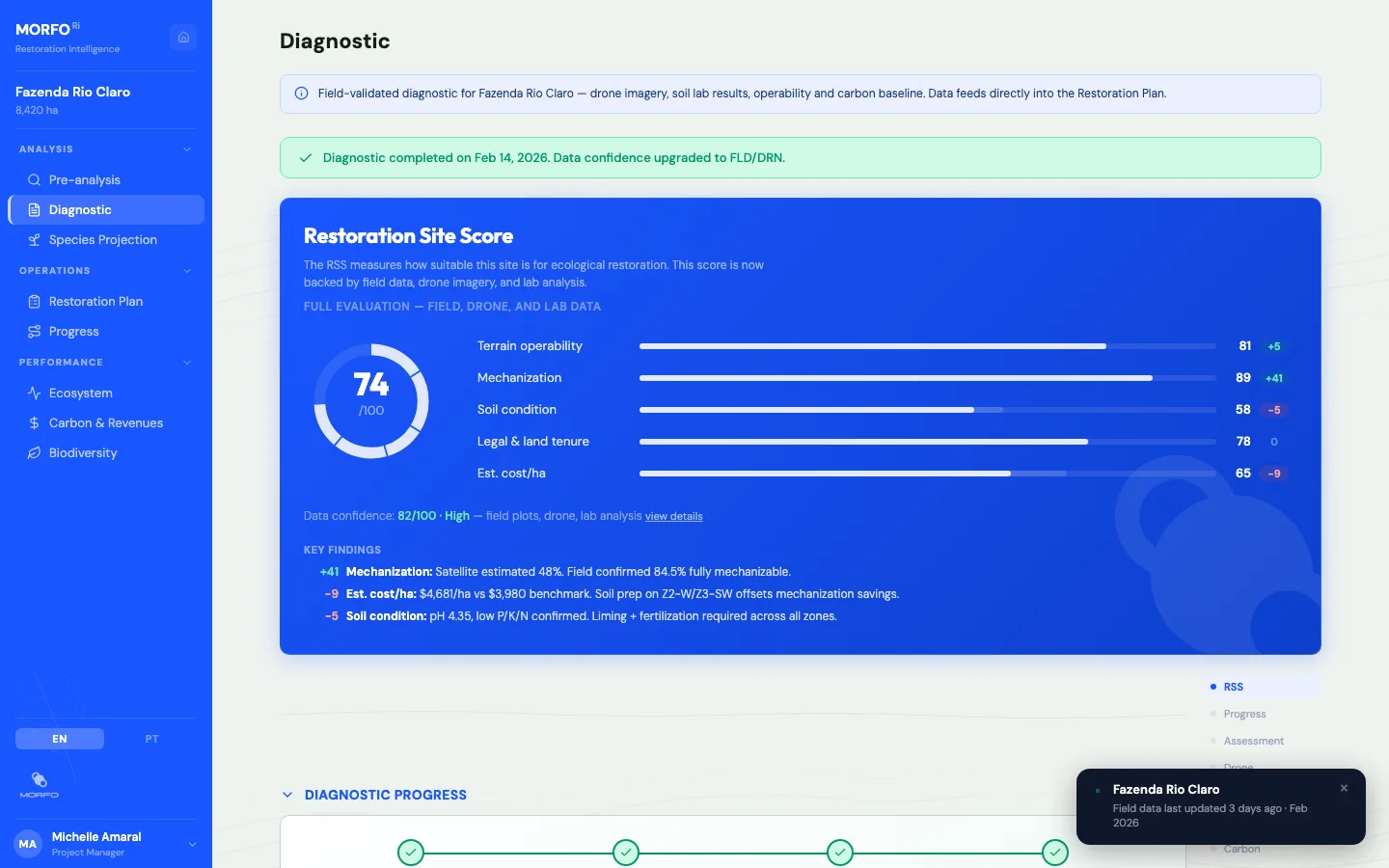
A traceable restoration plan looks like this: Zone Z1-N is prescribed mechanized line seeding with 35 species at 1,200 seeds/ha density. That prescription is based on: satellite slope analysis (SAT, 10m resolution, March 2026) showing less than 15 degrees gradient across 92% of the zone; field soil analysis (FLD, 6 plots, December 2025) showing pH 4.7, CEC adequate, compaction workable above 30cm; drone orthophoto (DRN, 2cm resolution, November 2025) confirming no erosion channels in mechanization corridors.
"Cross-referencing is what turns raw data into evidence. It is not about having a lot of data points. It is about linking them - connecting a soil pH value to the zone prescription it justified, and to the planting outcome it predicted. Without those links, you have files. With them, you have a case." - Jeremy Giral, Platform and Data Engineer, MORFO
The cost of not being ready
A failed or delayed verification does not just postpone credits. It creates a credibility deficit that compounds over time.
The VVB flags insufficient evidence. The project team scrambles to reconstruct documentation. Field visits are rescheduled. The verification timeline extends by months.
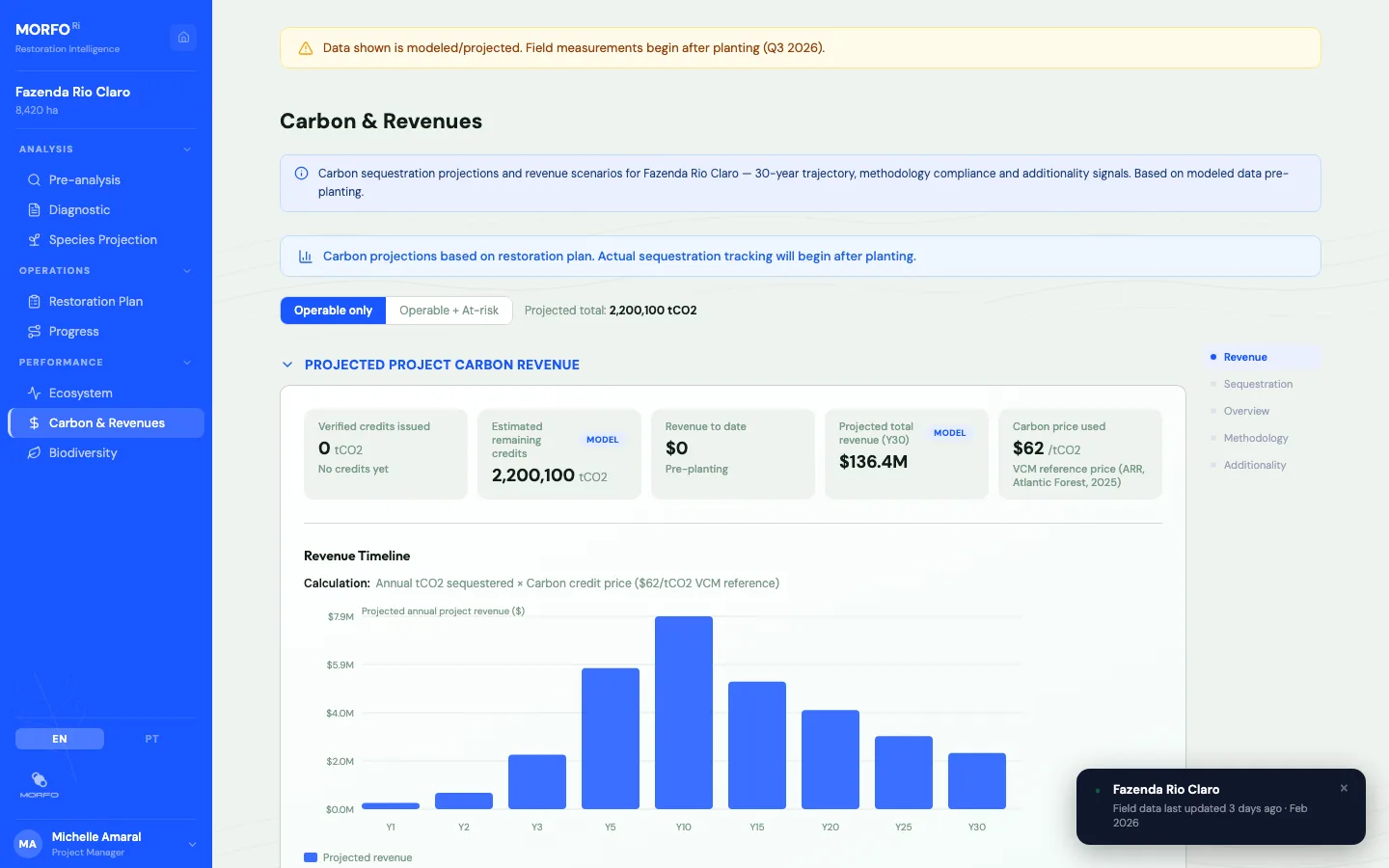
For a project that took two years from diagnostic to first planting, spending an additional six months reconstructing evidence for verification is not just a delay - it is a signal to investors that the project's data governance was not built for scale.
The alternative is straightforward: collect structured, traceable, timestamped data from the beginning. Tag every measurement with its source. Document every decision with its reasoning. Build the evidence chain forward, not backward.
Audit-ready is not something you become at the end of the project. It is something you are from day one, or not at all.
MORFO builds restoration intelligence for large-scale forest projects across three biomes in Brazil. 27,000+ hectares analyzed, 24 active projects, 1,900 hectares under management, 30 forest engineers and ecologists.
Request a site analysis or explore the platform at morfo.rest/restoration-intelligence