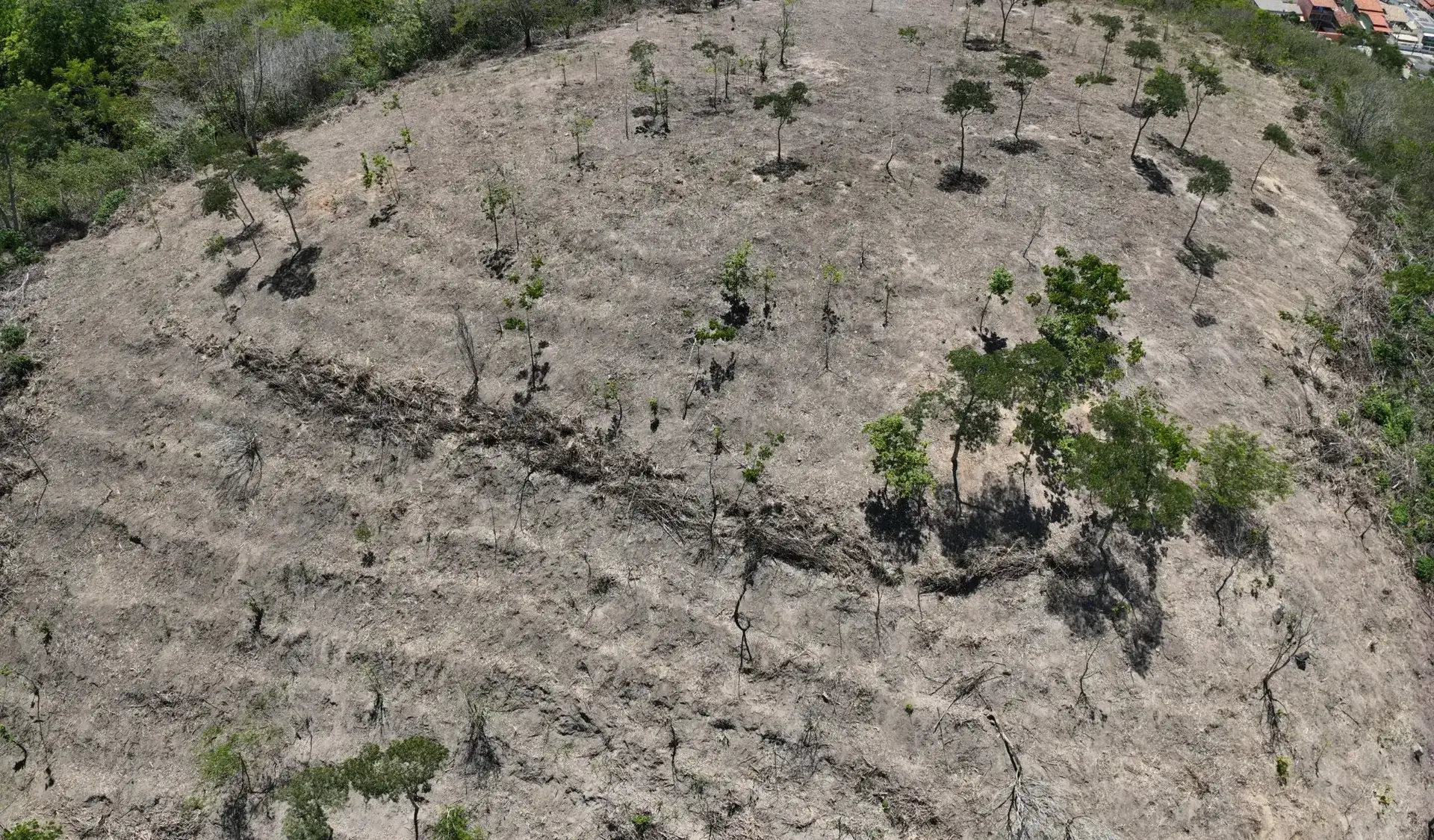

The planting window can be as short as seven weeks.
In tropical restoration, viable planting conditions depend on the rainy season. Seeds need consistent moisture to germinate. Seedlings need sustained rainfall to establish root systems before the dry season. In the Atlantic Forest region of Sao Paulo state, that window typically runs from late October to mid-December. Seven to ten weeks where conditions align.
Everything in a restoration project works backward from that window.
The chain before the first seed
Before planting can begin, a sequence of pre-activities must be completed, in order, with no step skippable.
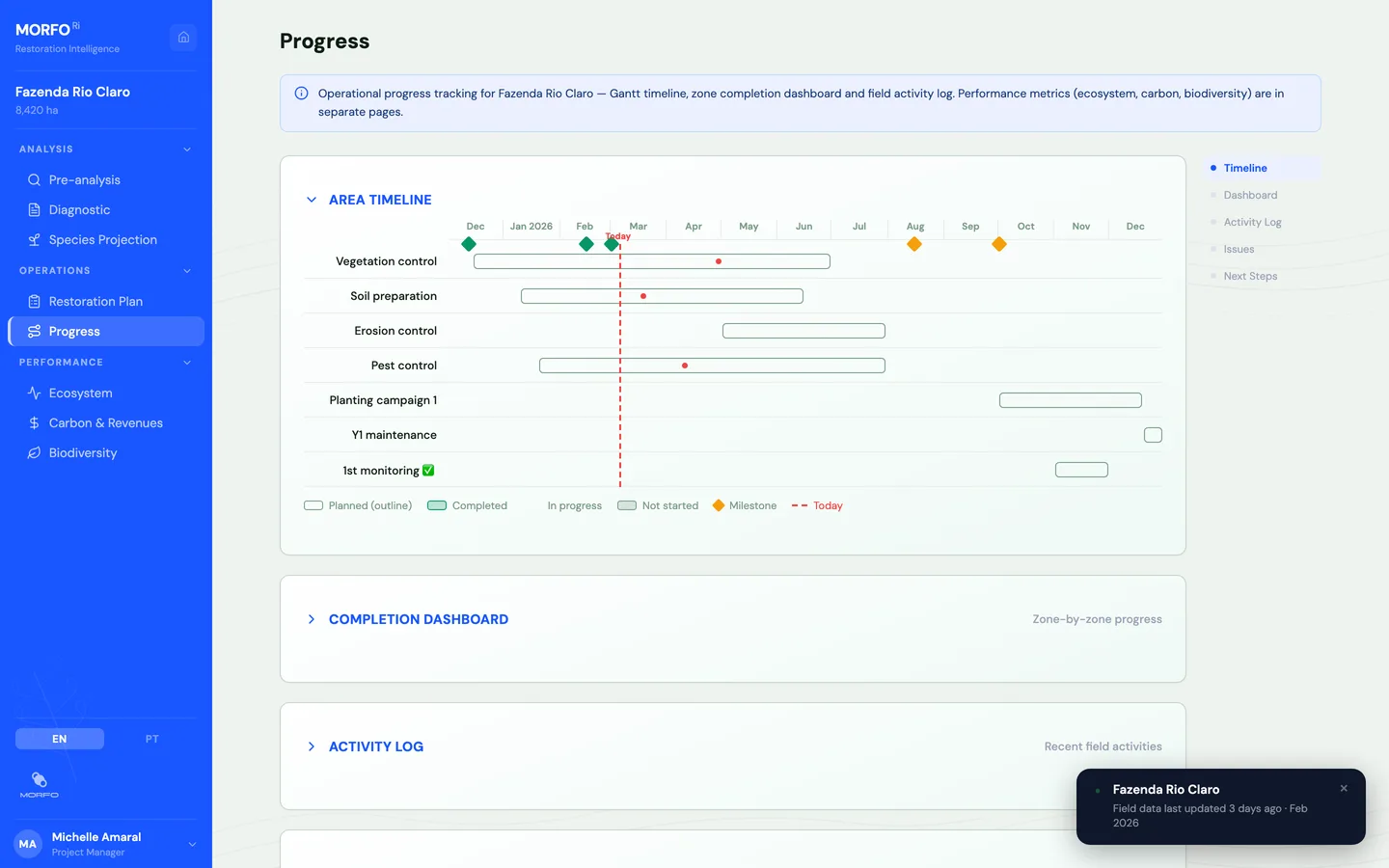
Vegetation control comes first. Invasive grasses must be cleared or suppressed. Depending on coverage and root depth, this requires mechanical clearing, selective herbicide application, or both. On heavily invaded sites, multiple rounds may be needed.
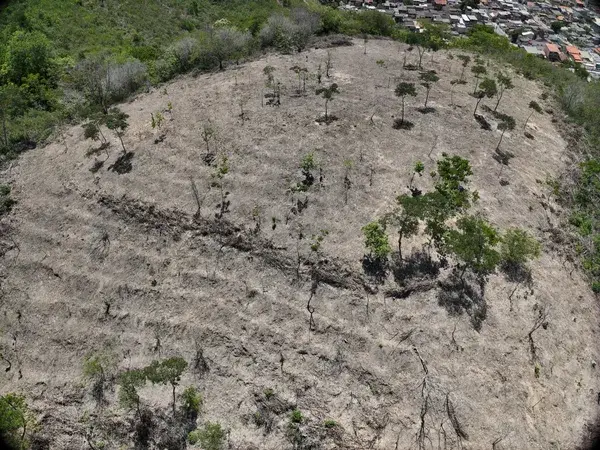
Soil preparation follows. On former pastureland, four to five disk harrowings may be necessary to break compacted root mats.
Access preparation runs in parallel. Equipment staging areas need to be cleared. Access roads must be passable. Seed supply chains must be confirmed.
Pest control cannot wait. Leaf-cutter ant colonies near planting zones can destroy seedlings within days of emergence.
"People see the planting day as the starting line. It is actually the finish line of months of preparation. If any link in that chain breaks, the planting day does not happen." - Pedro Bevilaqua, Environmental Engineer, MORFO
What causes delays
The most common cause of delay is underestimating soil preparation time. A diagnostic may show that the soil needs three passes of disk harrowing. But when the crew arrives, they find compaction deeper than expected. The three passes become five. The timeline shifts by two to three weeks.
The second most common cause is incomplete diagnostics. If the field campaign did not cover enough of the site, conditions may have changed.
Logistics failures compound everything. Equipment breakdowns. Seed deliveries delayed. Crew availability disrupted by competing demands - in some regions, coffee harvest season overlaps with restoration pre-activity timelines.
The cascade
A one-week delay on vegetation control does not cost one week. It costs the time it takes for that delay to propagate through soil preparation, seed logistics, and crew scheduling. By the time the cascade reaches the planting window, that one week may have become three.
If pre-activities are not complete when the window opens, the project faces a binary decision: plant on partially prepared ground and accept lower establishment rates, or defer the zone to the next season.
Planting on unprepared soil is almost always the wrong choice. Establishment rates can drop to 40-60% of target density.
Deferral costs a full year. Not just a year of waiting - a year of delayed carbon sequestration, a year of delayed first monitoring, a year of delayed crediting.
"A week of delay on pre-activities does not cost a week. It costs a year. Because the planting window does not negotiate. It opens when the rain comes, and it closes when the rain stops. Everything before that is either done or it is not." - Hugo Asselin, Co-founder and CTO, MORFO
The financial impact
For a carbon project, delayed planting translates directly into delayed revenue.
Consider a 5,000-hectare zone projected to sequester 30 tCO2/ha over its first five years. At a voluntary market price of $15-25/tCO2, that represents $2.25M-$3.75M in potential credit value from the first crediting period alone. A one-year delay shifts the entire revenue curve by twelve months.

For compliance restoration - Reserva Legal obligations, mining rehabilitation, PRAD commitments - delayed restoration means delayed compliance means continued exposure to fines.
The planting window is not a soft deadline. It is the hardest constraint in the entire project.
Planning backward from the window
Every operational timeline in restoration should be built backward from the planting window, not forward from the project start date.
If the window opens October 29, and soil preparation requires four weeks, and vegetation control requires three weeks before that, then vegetation control must begin by August 14 at the latest. Add two weeks of buffer, and the real start date is August 1. Add diagnostic completion time, and the chain extends back into May or June.
Seven weeks. That is all the rain gives you. Everything else is preparation.
MORFO builds restoration intelligence for large-scale forest projects across three biomes in Brazil. 27,000+ hectares analyzed, 24 active projects, 1,900 hectares under management, 30 forest engineers and ecologists.
Request a site analysis or explore the platform at morfo.rest/restoration-intelligence