
When MORFO started, we did one thing: drone-based seeding of degraded land in Brazil. Three years of research and field operations gave us solid survival numbers on that technique. So when a prospective client called, the natural question was "what is your survival rate?" It was a fair question. We had a clean answer.
That is no longer where the conversation should start.
Today we operate across drone seeding, semi-mechanized planting, manual planting, nucleation, direct seeding, and active natural regeneration. Survival rate still matters. Once a planting technique is committed on a given zone, knowing it precisely is non-negotiable. But it is not the number that tells you whether MORFO is delivering.
This article explains the distinction between strategy and technique, and why the right entry question for restoration sits upstream of any survival rate.
Survival rate is a HOW. The question that matters is the WHY.
A planting technique (drone, seedling, direct seeding, manual) is a means. It produces a survival rate as a by-product. Before we choose a technique, however, we choose a strategy. Conflating the two is what makes survival rate look like the right entry question when it is not.
Technique is operational. It answers: which method are we using on this zone? Drone? Seedlings? Direct seeding? Manual nucleation? Each method has its own survival profile, well documented in our internal data and in the literature.
Strategy is upstream. It answers a much harder question: given everything we know about this site, what combination of methods across which zones, with which species mix, on which calendar, with which monitoring intensity, is most likely to deliver the contractually committed outcomes?
You cannot pick a technique without a strategy. You cannot pick a strategy without data.
What goes into a strategy: 30+ indicators across 12 categories
Before any technique is committed, MORFO Ri runs a pre-project diagnostic that consolidates more than thirty geospatial datasets into twelve indicator categories, including :
- Vegetation health and dynamics. NDVI baseline, three-year trend, degradation index against the biome reference.
- Topography and slope. Mechanization feasibility from elevation data.
- Water balance and seasonality. Rainfall, evapotranspiration, dry-season length, optimal planting window.
...and many others!
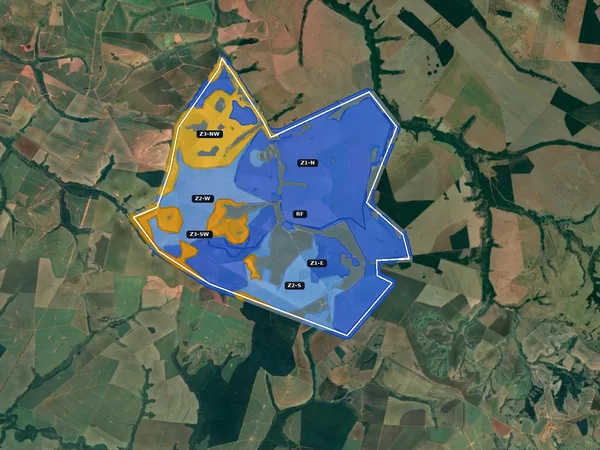
These categories feed a composite restorability score and a spatial breakdown that exposes internal heterogeneity within the site. They do not pick the technique. They define the constraints inside which any technique choice has to make sense.
Choosing a technique without this work is choosing a survival rate without choosing what it is supposed to mean.
From strategy to operations: four levers per zone
Once the strategy is fixed, the operational work decomposes into four levers per zone:
- Soil preparation and invasive control. What the seedling lands in.
- Species mix. What is being planted, and in what ratios.
- Planting methodology. Drone, seedling, direct seeding, manual. Survival rate enters here.
- Maintenance protocol. What happens between month zero and year three.
Survival rate is one signal generated by one of four operational levers, downstream of a strategy that synthesized 30+ data sources. Asking about it first is asking about the third decimal place before fixing the integer.
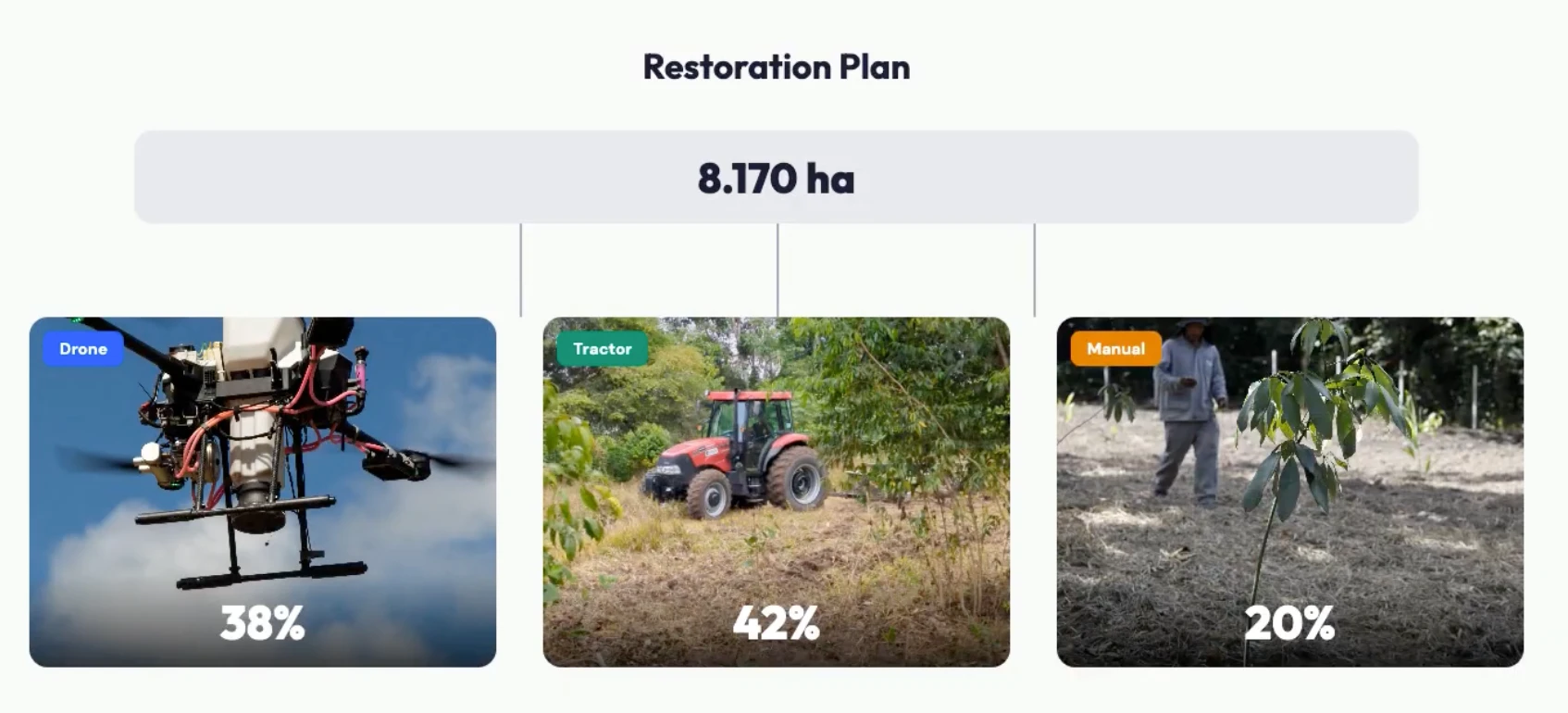
Survival rate is method-specific
Even within the planting methodology lever, "survival rate" is not the same object across techniques. The biology underneath is different.
In seedling planting, every individual reaching the field is already an established plant. If 1,646 seedlings go into a hectare, the goal is for as many of those 1,646 as possible to stay alive. Survival rate measures exactly that: the share of planted individuals still alive at a given time. It is the right metric for this method.
Direct seeding is a different biological process. Not every seed is expected to become an established plant. The path is sequential: germination, then establishment, then survival. Only a fraction of sown seeds will progress through each stage. This is built into the process and planned for from the start.
For direct seeding, the meaningful indicators are germination rate (how many seeds emerged) and establishment rate (how many germinated seedlings rooted into the environment). A "survival rate" calculated from the total number of seeds sown does not describe what is actually happening biologically.
A buyer asking "what is your survival rate?" without specifying the method is asking for a number that does not exist as a single comparable value.
We do not commit to efforts. We commit to results.
Here is the part that matters most for a buyer making a real decision. If survival rate is one signal among many, what does MORFO actually commit to?
We commit to KPIs. Co-defined with the client, written into the contract, tied to a performance-based pricing structure.
Unlimited corrective actions until KPIs are met. Contractually. If we underperform on density, cover, species composition, or any other agreed metric, we come back to the field at our cost as many times as needed to close the gap. The client buys an outcome, not a delivery.
Performance guarantee on top of the corrective actions. Tied to points of IRR or hybrid commercial models, depending on the project. Underperformance triggers penalties. Overperformance is shared. This part of the contract is currently being formalized across our active projects.
This commercial structure is what makes survival rate our problem rather than the buyer's. The buyer does not need to audit our survival rate at month four. The contract puts us on the hook for the actual outcome at year three. A weak survival number triggers our corrective actions, not their renegotiation.
What makes the commitment honorable: MORFO Ri
Standing behind the commitment is a platform we call MORFO Ri. It does three things in particular.
- Diagnostic. The 30+ indicators above, run before any methodology is committed, surfaced as a restorability score and a zone-by-zone feasibility breakdown.
- Zone-level planning. Methodology mix per zone with cost-per-hectare projections under different scenarios. The planning logic that turns a site score into a defensible execution plan.
- Continuous monitoring. Plot-level history of decisions, species, and methods. Continuous, longitudinal, verifiable. Every hectare audited.
The platform is the reason we can write "unlimited corrective actions until KPIs are met" into a contract without losing money on it. The earlier we see a deviation, the cheaper the correction, and the data infrastructure exists to see it early.
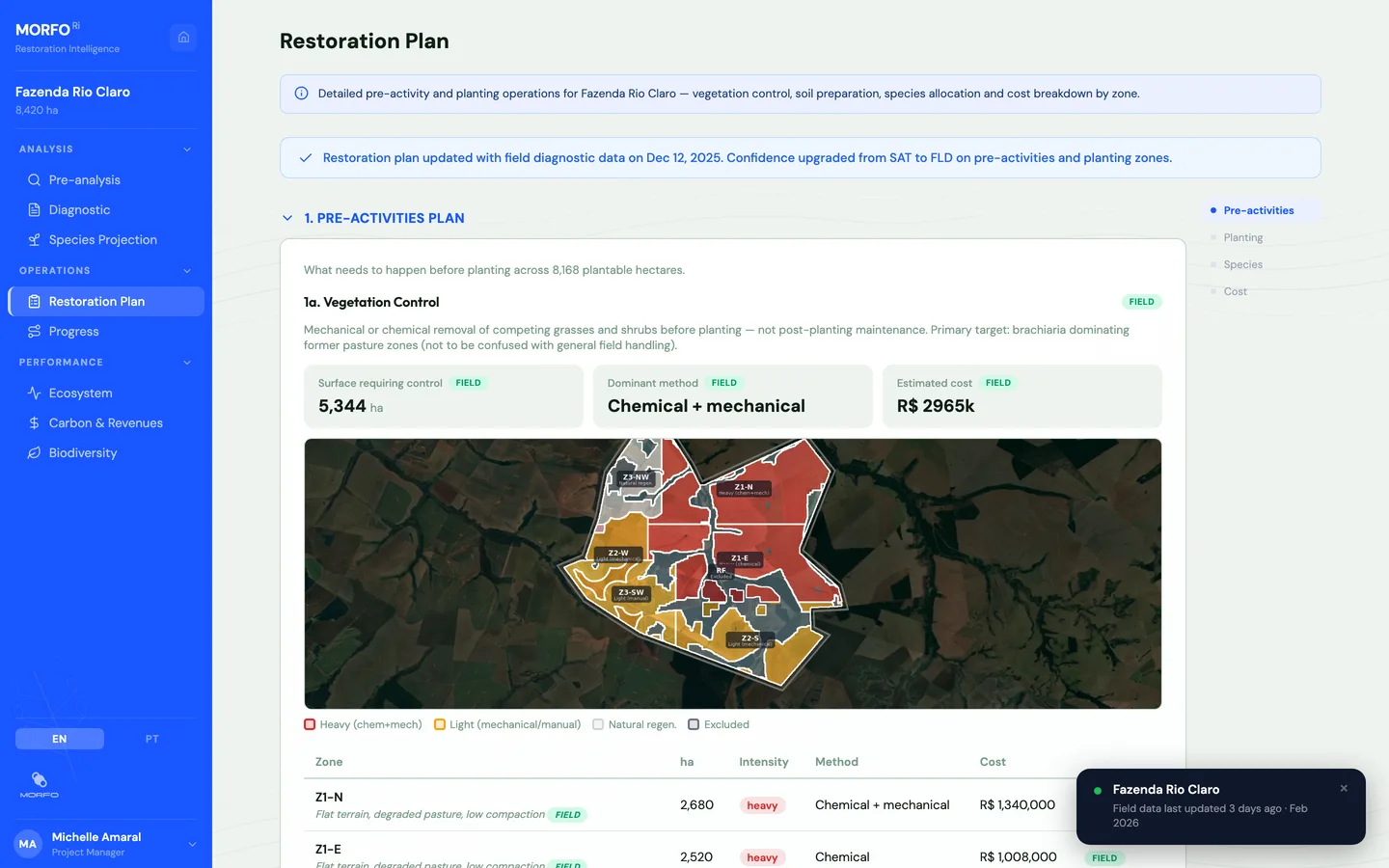
Three questions worth asking instead
If we could replace "what is your survival rate?" with three questions for a first call, they would be:
- What is the strategy, and what data informed it?
- How is the area broken into zones, and what technique applies in each?
- What are you contractually committing to deliver, and what happens when reality diverges from projection?
The third question is the one that turns restoration from a service line into an investable asset. That is the conversation we are now having with our most serious counterparts. The shift is already underway in the market.
MORFO Ri, the platform behind every method choice
Choosing the right method on a given zone isn't a judgment call made in a meeting. It runs on data, on prior projects, and on scientific work that took years to consolidate. MORFO Ri is the platform we built to make those decisions structured, sourced, and traceable.
It fuses four data sources per site: satellite imagery, drone surveys, field measurements (soil profiles, floristic inventories, plot-level data), and models. The models embed the scientific foundations developed by MORFO with our partners at Embrapa, UFV, and UFSCar. Every recommendation, by zone, is anchored to its inputs.
That's how we move from "MORFO's survival rate is X%" to "on your zone 3, with this soil, this slope, this invasive pressure, this access, this method delivers Y% establishment for Z cost per hectare".
Survival isn't only an indicator. It's also a commitment.
On every site we operate, MORFO tracks survival rates, density and species diversity, soil cover by native and by invasive species, and mortality with spatial breakdown. When carbon is in scope, we add above-ground biomass measurement.
Usually, on the restoration market, the planting company gets paid for what they plant, not for what survives. If 30% of the seedlings fail in year one, you pay again to replant. The partner has no downside if your site underdelivers, no upside if it overdelivers.
MORFO offers different structures. For clients who want a stronger guarantee, we can take on the first year ourselves: if a zone fails to establish, we come back and replant within year one, at our cost. For clients who want to align incentives over the longer run, we put part of our payment at risk against outcomes agreed upfront, such as survival, establishment, or biomass at defined monitoring points. If your site underdelivers, we lose money. If it overdelivers, we earn more. The exact mechanics vary by project. The principle stays the same: we share the risk with you because we stand behind what establishes on the ground, not behind the act of planting itself.
This only works because of the diagnostic and monitoring stack behind it. We project performance per zone before we plant, and verify it continuously after. We commit on what your land can actually deliver, zone by zone, not on a single number applied uniformly to a heterogeneous site. A blanket survival commitment on fragmented land with mixed slope, soil, and invasive pressure isn't a serious commitment. A zone-by-zone projection, with a method matched to each zone and a monitoring stack that catches deviations early, is.
In practice
Survival rate is the right question to ask. The useful answer is the one that explains what survival will be on your specific land, given your terrain, your invasive pressure, your access, and the method we're recommending. That answer takes a diagnostic to produce and a monitoring stack to verify over time.
Our value as a partner is the ability to adapt the method to the land, not to defend a single approach. The full mechanics of how we calibrate that adaptation stay where they belong, in the work we do with our clients. What we share here is the logic, not the recipe.