Four subjects that get a restoration project built in Brazil
Pascal Asselin · 2026-10-07 · 14 minutes
Over the past year I have had the same conversation with several international investment teams. They want a native restoration project in Brazil, for good reasons: the largest land potential in the world, forest science that already has more than 50 years of proofs, seed collection networks established, an ecosystem of nurseries, and a domestic carbon market being built into law.
But here's the spoiler: none of those teams has started a project yet.
Why? At least four subjects come back every time. There are certainly others. But these four take up most of the time today.
1. The price per hectare
Native restoration in Brazil is usually quoted somewhere between 2,000 and 6,000 US dollars per hectare. It can go well above that when the conditions are difficult, and well below it on areas where assisted natural regeneration does most of the work.
Two separate things worry a committee here: how high the price is, and how much confidence can be placed in the number. The good news is that both have improved.
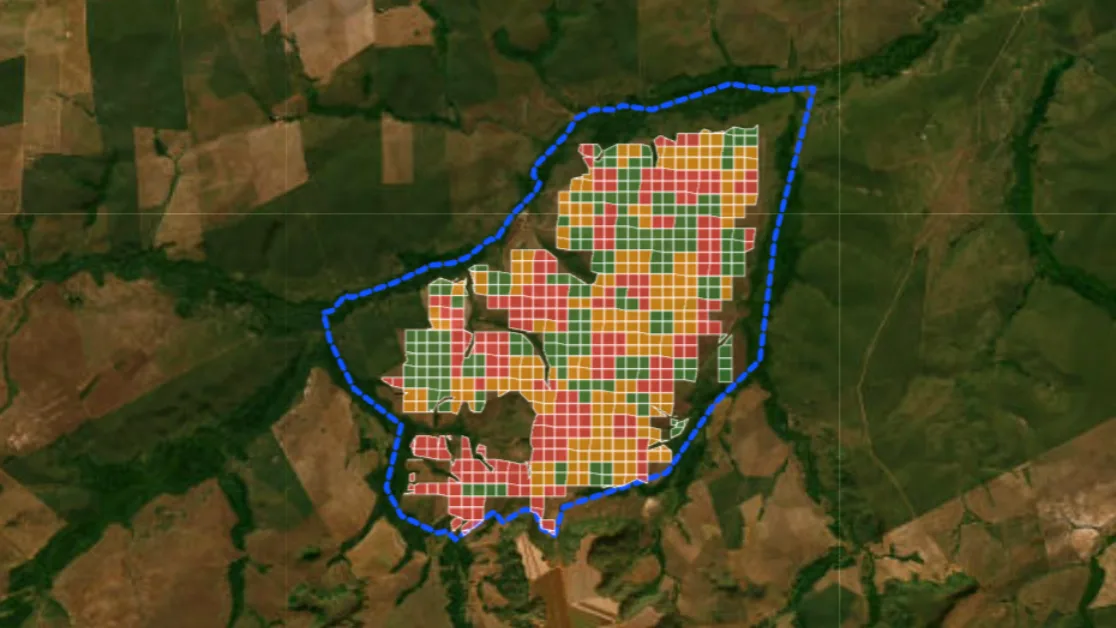
On the price itself: the cost comes down when the method is adapted block by block instead of applied uniformly. There are many tools available, from assisted natural regeneration to direct seeding with or without drones, seedling planting, multimodal planting, nucleation and enrichment. At MORFO, for instance, we now have more than 130 restoration protocols validated in the field, and the reason for having that many is that the right combination changes inside a single property. For example, on a 9,019 hectare plantable area in the Cerrado, the plan defined 605 talhões across three management classes, each with its own soil preparation and maintenance schedule.
On confidence: a range with a floor and a ceiling can now be produced early, and it tightens as the work goes on. A pre-analysis runs on the whole perimeter from satellite, covering legal status, rainfall in dry years, land use, slope, rock, and fire and deforestation pressure around the area. A drone flies only where the satellite shows something that needs to be investigated or confirmed. People go on the ground only where a decision still needs a soil sample or a species check. Our own models cross around twenty data sources this way and compare each perimeter against a base of more than 60,000 hectares already analysed. ** The range that comes back is built on that specific site rather than on a market average**, and every step of fieldwork narrows it.
None of that makes a difficult site cheap. But of the four subjects here, this is the one where I have seen the most progress. Clearly, everyone now agrees that an initial land diagnostic is required. That wasn't the case three years ago.
2. The contract with the operator
Very few project developers plant their own hectares. The work goes to implementation operators, and the contract between the two sets most of the project's economics.
Today, most of those contracts pay for activity: hectares prepared, seedlings planted, maintenance passes completed. It is easy to verify and easy to invoice.
It also puts the two parties on opposite sides of every hectare. The implementer's revenue grows with the volume of work performed, so its interest is to do more of it, and sometimes to do it slower. The project owner pays for that same volume, so its interest is the smallest intervention that still reaches the target. Whoever designs the plan therefore decides the other party's economics.
The problem gets sharper when a block fails. Under an activity contract the work was delivered as specified and the invoice was already paid, so the cost of doing it again sits with the project owner. The party that chose the method carries none of the consequence of the method.
We changed our own contracts for that reason. What we want is to move away from a market that pays for an hour or a day of work, and to be paid for the result instead. So the ecological targets go into the contract, and missing them becomes our problem rather than the client's: corrective work at our cost until the targets are met. It is a bit bold, and yes, we are taking a risk there.
That commitment only means something if the evidence behind it holds, which in practice means monitoring the whole area at every stage rather than working by sampling. A block that fails in its first year and surfaces at the third-year audit is a replant, or even a whole new project. The same block caught in its sixth week is a correction.
3. The allocation of risk
Risk sits in different places depending on the type of project. Three of them come up in almost every discussion. The first is financial. The other two travel together, and they are the ones we work on.
I am deliberately leaving aside the risks everyone already has on their list: fire, cattle getting into young plantings, land tenure security. They are real, sometimes the biggest ones on a given site, and they deserve their own discussion. They are simply not where I see the confusion today.
The financial one sits in the absence of collateral. Renato Rosenberg, who runs concessions at the Brazilian Forest Service, put it plainly: a forest is an economic asset and a financial liability at the same time. It cannot be pledged, and while it grows it produces no cash, so a project that earns nothing for years has no security to offer a lender and no revenue to service debt. Esben Brandi, who leads business development at BTG Pactual Timberland Investment Group, made the other half of the point in another LinkedIn article: money rarely stays as money, it settles into asset values, which is how farm support ends up inside land prices. ** Value settles where the income is, and a young forest has none yet.**
The change this year came from the public side. At the last Brazilian Climate and Carbon Conference, Marcus Santiago of BNDES described a second phase of the ProFloresta+ programme: up to R$6bn to buy restoration credits, a 60,000 hectare target, financing for the winners at around 2.3% a year over 25 years with four to five years before the first repayment, and project finance against the project's own carbon receivables as the next step. A long tenor and a grace period are what a forest's cash flow needs.
The other two always appear together. The ecological risk, that the forest does not establish as the plan assumed. And the operational risk, that teams, machines and logistics do not deliver what the plan assumed.
They are hard to tell apart, because on the ground they produce the same picture: a block where nothing established. That block can mean the species mix was wrong for that soil, or the soil preparation went in at the wrong depth, or a maintenance pass was skipped, or the rain did not come. The first cause belongs to whoever designed the plan, the next two to whoever ran the operation, and the last one belongs to nobody. ** So the first job when something goes wrong is to establish which of the two risks occurred**, and that takes evidence gathered before the discussion starts rather than after.
That is why we monitor the whole area at every stage rather than by sampling, and record what was decided and by whom whenever the plan changes in the field. Separating the two risks, and writing down who holds each, is one of the central subjects in our discussions with partners. The ecological result sits on our side, with corrective work at our cost. The operational result stays with the company that mobilises the teams and the machines. A lender taking risk on a carbon receivable needs someone answerable for the tonnes existing, and that cannot be everyone at once.
4. The team on the ground
Everybody knows local presence matters. The hard part is finding the operators who have it, and verifying that they do before signing.
Local roots mean something concrete: knowing the communities living around the area, knowing the micro-climates and the local calendar, and having actually operated on that ground. A network can be built. Experience of that specific ground only accumulates by working it. Thibault Sorret, who runs Equitable Earth, a carbon standard active in Brazil, said at the same conference that after several years in the country he is still surprised by assumptions that hold everywhere else and turn out to be wrong on a given site. He added what sits behind that for a buyer: the project is sold on a forty-year horizon, and what the buyer really wants to know is which of the companies around the table will still be working on that ground in a year.
At the farm gate the same thing sounds simpler. Richard Smith, executive director of Instituto PCI in Mato Grosso, describes four questions every producer now asks whoever turns up at the gate with a restoration project to sell: what do you want, where are you from, where have you done this before, and how much will I earn. Without a solid answer, eye to eye, you can go back home.
There is a second reason the people around a project matter, and it starts with the seeds. Native restoration needs tens of species, and they are not available on Mercado Livre. They are collected, in season, by people who live within reach of the area. We have catalogued 490 native species, and the supply behind them is a local network rather than a supplier. So the communities around a project are already inside its critical path. A project that builds that network pays less for its seeds, loses less time to conflict, and ends up with neighbours who have a reason for the forest to still be standing in ten years. That is not a social chapter added to the budget. It is one of the lines that decides whether the budget works. We call it enabling infrastructure: everything that has to exist around a project before the first hectare can be planted.
The company that reads the land is rarely the company that mobilises three hundred people and a machine fleet, and I really don't think scale comes from one player doing everything. We'll soon start our 30th project in Brazil, across three biomes. Our conviction is that an investor getting started here needs both sides covered: someone answerable for the ecological result, and an industrial operator answerable for execution. We take the first. We bring the second in rather than pretend to be it.
Where this leaves the conversation
Those are the four subjects, and each of them could take a week on its own. What I wanted to do here was set out where each one stands today rather than close it.
Something paradoxical is going on in this market. It now has real success cases, and starting a project has still become harder. Tiago Ricci, partner and director at Systemica, a Brazilian carbon project developer, gave a number at the same conference that I keep in mind: selling a credit used to take two days of conversation, and an offtake contract now takes twelve to eighteen months of due diligence. The bar has risen, and I think that is good news. A market that asks harder questions is a market getting ready to scale. But it does mean that intentions alone no longer get a project started.
So I will leave it open. If you are looking at Brazil and one of these four is the one holding you up, I would be glad to talk about it.
One note on sourcing. Our conversations with funds and other players are confidential, so I could not use them. Instead I leaned on what professionals in the industry said publicly on stage at the Brazilian Climate and Carbon Conference in São Paulo, organised by the NBS Brazil Alliance.