Natural regeneration in a Legal Reserve: measure how much regrows on its own before planting native trees
Luisa Ritzmann Peceniski · 2026-11-23 · 7 minutes
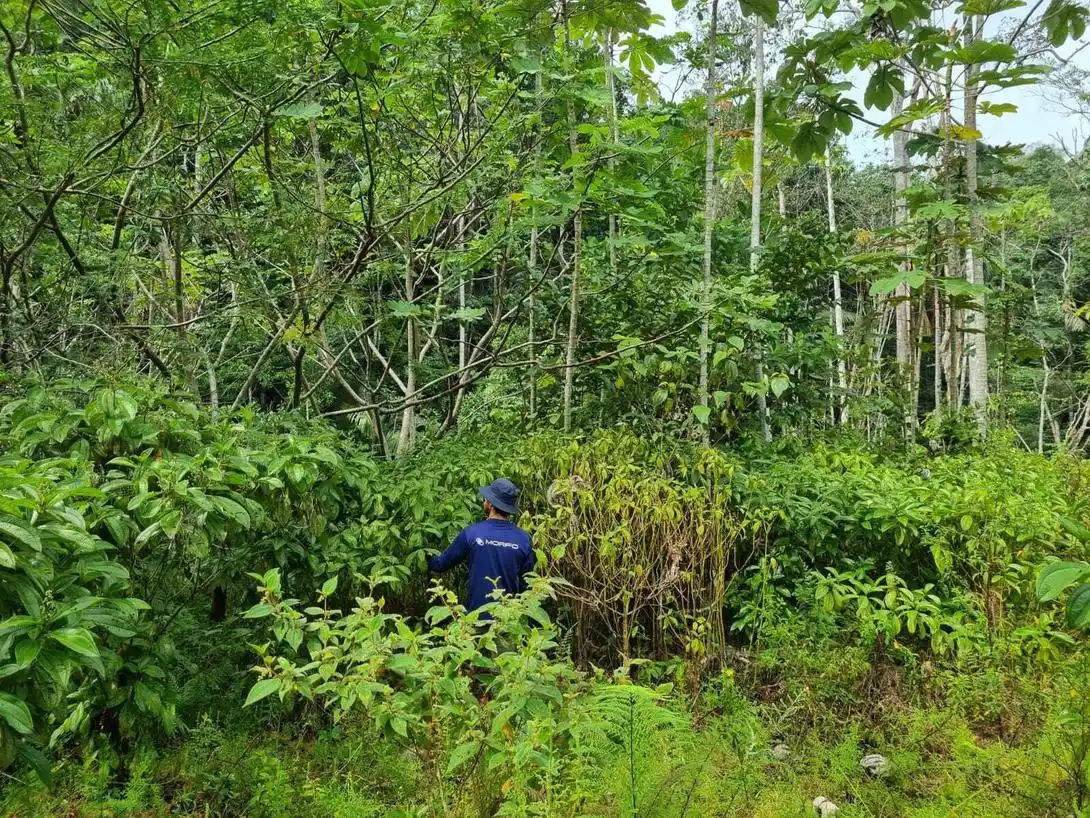
This page is for a landowner or a company that has to recompose a Legal Reserve in Brazil and wants to know how much of it will regrow without planting.
The short answer: before budgeting a planting, measure how much of the area can regrow on its own, plot by plot, because that share varies enormously from one property to the next. The Forest Code accepts natural regeneration as a way to recompose a Legal Reserve. It works where there is a seed source nearby, native plants already coming up and pressure that can be controlled, and the agency will still expect proof that the vegetation is recovering.
What the Forest Code allows
The Forest Code (Law 12,651 of 2012, article 66) lets a landowner regularise a Legal Reserve deficit by recomposition, natural regeneration or compensation, alone or combined. For APPs, article 61-A lists similar options: conducting natural regeneration, planting natives, or both. Natural regeneration is a legal method in its own right, not a fallback.
The details, what has to be shown and how often, sit in each state's Environmental Regularisation Programme (PRA) and in the terms the landowner signs. What an agency accepts as proof of natural regeneration has to be checked state by state, and against the project's own constraints: its licence or PRA terms, its deadline, and what the agency has already asked of that landowner. These rules are also updated over time, so the version in force on the day matters.
Signs that a plot can regrow on its own
Natural regeneration is not a bet on luck. A few signs, read in the field and from imagery, say whether a plot has the means to come back:
- A seed source nearby, in good condition. How far the forest fragments are from the plot, what state they are in, and how much they can regenerate themselves. A conserved, diverse fragment close by, connected to the plot by birds, bats and wind, feeds it far better than a degraded one.
- Native plants already there. An active bank of seedlings, saplings and resprouting stumps, counted in the field.
- Controllable grass. Invasive grass that is weak or patchy rather than a dense carpet.
- A short or light history of use. Years of pasture or crops, repeated fires and heavy machinery reduce the soil's seed bank. The MapBiomas annual series shows how long and how a plot has been used.
- Soil that still works. Not so compacted or eroded that seeds cannot root.
Where several of these signs are present, protection and a little help may be enough. Where none are, waiting will mostly produce grass.
Native vegetation grown back (2025)
Explore a location
Reading the whole area before deciding
On a Legal Reserve, these signs change from one plot to the next. That is why the reading has to cover the whole area, not a few sample points:
- Satellite imagery and the MapBiomas series separate plots already under native vegetation, plots that have been regrowing in recent years and plots that have stayed open.
- Drone flights show canopy gaps, grass cover and the edges of fragments at a scale satellites cannot reach.
- Field plots count regenerating plants and species where a decision depends on it.
On one perimeter we analysed, about 70% of the area showed potential for natural regeneration. On another site the share will be very different. The point is not the percentage; it is that nobody knows it before reading the land.
"Two plots already had native forest ten years ago. They come out of the perimeter now, in the diagnostic, and not three years from now in front of the auditor." Pedro Bevilaqua, Environmental Engineer, MORFO, on a farm analysed in July
In this video, Pedro shows which sources we cross to read a degraded area, and what that reading changed on that farm (in Portuguese).
When the work itself can destroy regeneration
This season we discussed a Legal Reserve on sandy, poor soil where the planned preparation was a light harrowing of the whole area before planting. The field visit found an active bank of native seedlings and regenerating plants, a large forest fragment nearby and weak grass. A harrowing risked destroying part of what was coming back on its own.
In the end, the plan dropped harrowing altogether. On that sandy soil, harrowing also raised the risk of erosion. Preparation was limited to subsoiling along the planting rows, and the grass between rows was left in place and controlled during maintenance.
The case shows a risk that is rarely discussed: a standard planting protocol applied to the whole area can remove the natural regeneration that would have done part of the work for free.
Helping regeneration: from protection to enrichment
Between doing nothing and planting everything there is a range of interventions, chosen plot by plot:
- Protection. Fencing out cattle, firebreaks, removing the cause of degradation.
- Assisted regeneration. Controlling grass around native plants (crowning), guiding resprouts, working the soil in patches.
- Enrichment. Planting or seeding a few species that are missing, often the ones that do not arrive on their own.
- Full planting. On plots with no seed source, no regrowth and strong grass.
The methods themselves are compared in comparing reforestation methods. The relationship between regeneration and planting is older ground for us, covered in forest succession: reforestation and natural regeneration are complementary.
Proving that the area is recovering
Choosing regeneration does not remove the need for evidence. The agency will ask whether the vegetation is coming back on the trajectory the PRA expects. Some states publish the indicators. São Paulo's Resolution SMA 32 of 2014 counts native vegetation cover, density of native regenerating plants and number of regenerating species, with reports at 3, 5, 10, 15 and 20 years. A plot left to regenerate should be monitored with the same care as a planted one, so that a plot that does not take off is detected early and moved to enrichment or planting.
How MORFO decides what to plant and what to leave
Our diagnostic reads the whole area before any cost is set. Plots already under native vegetation are taken out of the planting budget, plots with strong regeneration go to protection or assisted regeneration, and full planting is kept for the plots that need it. We then monitor 100% of the area plot by plot, so a plot left to regenerate that does not respond shows up in time to change its treatment.
On a Legal Reserve, the cheapest hectare is often the one nobody needs to plant, provided someone has checked that it really will come back.
Frequently asked questions
Can a Legal Reserve be recomposed by natural regeneration? Yes. Article 66 of the Forest Code lists natural regeneration as a method, alone or combined with planting or compensation. How it has to be shown depends on the state's PRA and on the project's own terms, and should be checked case by case.
How do you assess natural regeneration potential? By reading the distance to forest fragments, the native plants already present, the grass cover, the history of use and the state of the soil, plot by plot, with imagery and field counts.
How long does natural regeneration take in a Legal Reserve? It depends on the site. Plots with a nearby seed source and an active seedling bank recover much faster than plots with dense grass and a long history of pasture, which may not regrow without help.
What happens if a plot left to regenerate does not respond? Monitoring shows it, and the plot moves to enrichment or planting. That is why leaving a plot to regenerate should come with dated checks, not a single inspection at the end.
Can natural regeneration and planting be combined on the same Legal Reserve? Yes, and it is often the most economical plan: protection or assisted regeneration where plots regrow, enrichment where species are missing, full planting only where nothing comes back. The Forest Code allows the methods to be combined.