Who pays when a native forest restoration fails: sharing ecological risk in the restoration contract
Pascal Asselin · 2026-11-23 · 7 minutes
This page is for a company that is about to sign a native forest restoration contract in Brazil, for a Legal Reserve, an APP, a PRAD or a licence condition, and wants to know what happens to its budget if the trees do not grow.
The short answer: in most restoration contracts today the client carries the ecological risk, because the contractor is paid for work done and replants only a limited share of losses for free. A fair split puts the risk on whoever controls it. The contractor answers for the plan and the result on the plots it prescribed, the client answers for the land it handed over, and the events nobody controls are named in the contract and priced or excluded.
How the risk is split in most contracts today
Over the past year I have read a lot of restoration contracts, ours and other people's. Most of them follow the same pattern. The client, or its consultancy, writes the plan. The contractor executes it and is paid by the activity or by the day. If seedlings die, the contractor replants a limited share of the planted stock, checked a few months after planting. Beyond that, the client pays.
In that model a failure costs the contractor almost nothing, and the final cost is only known at the end. Nobody in the chain is paid for the forest actually growing. The client finds out in year two or three whether the plan worked, and by then the cheapest fix is another planting season at its own expense.
Which risks sit in a restoration project
It helps to separate the risks by who can act on them. In a native restoration project in Brazil there are four families:
- Plan risk. The wrong method or species for a plot, a soil that was not corrected, a calendar that misses the rains. Whoever wrote the plan controls this.
- Execution risk. Poor seedlings, late planting, maintenance rounds skipped. The contractor controls this.
- Land risk. An area that does not match what was described, access that is not granted, a neighbour's cattle, a fire started on the property, herbicide sprayed by a third party. The landowner or the client controls most of this.
- Climate and force majeure. A drought, an El Niño year, a flood. Nobody controls it, but it can be anticipated and partly priced.
Most disputes come from the third and fourth families, because the contract never named them.
The clauses that decide who pays
When I read a restoration contract, these are the clauses I look for first:
- The success indicator. What is measured, when, and by whom. Survival of planted seedlings is the common one, measured once in a joint inspection, for example between day 150 and day 180 after planting. For direct seeding, the indicator has to be defined in a protocol approved before implementation, because germination and establishment do not follow the same clock.
- The exclusions. Losses caused by force majeure, by the client, by the landowner or by third parties (cattle, machinery, fire, spraying, embargo, occupation) are taken out of the calculation. So are losses on an area that did not match the technical premises.
- The corrective actions. Who replants, how many times, and up to what ceiling.
- The climate window. Whether a delay caused by waiting for the right rains counts as the contractor's delay or not.
- The exit points. Whether either party can stop at the end of a season, and on what terms.
What a fair split looks like
A fair split follows control. The contractor that writes the plan from its own diagnostic should answer for the result on the plots it prescribed. The client should answer for the land it hands over: access, ownership, protection from cattle and fire. The events nobody controls should be named, and either excluded from the commitment or carried by the party best able to absorb them, against a premium.
The commitment should be a dated trajectory with ranges, not one target at a fixed date. For example: 18 to 20% vegetation cover at six months, 20 to 40% at one year, 30 to 60% at two years, with a reading at each step. A plot that drifts shows up early and gets its own corrective action. A single target at year three only tells you that you failed, too late to do anything about it. We went into how that evidence is built in what audit-ready means for a restoration project.
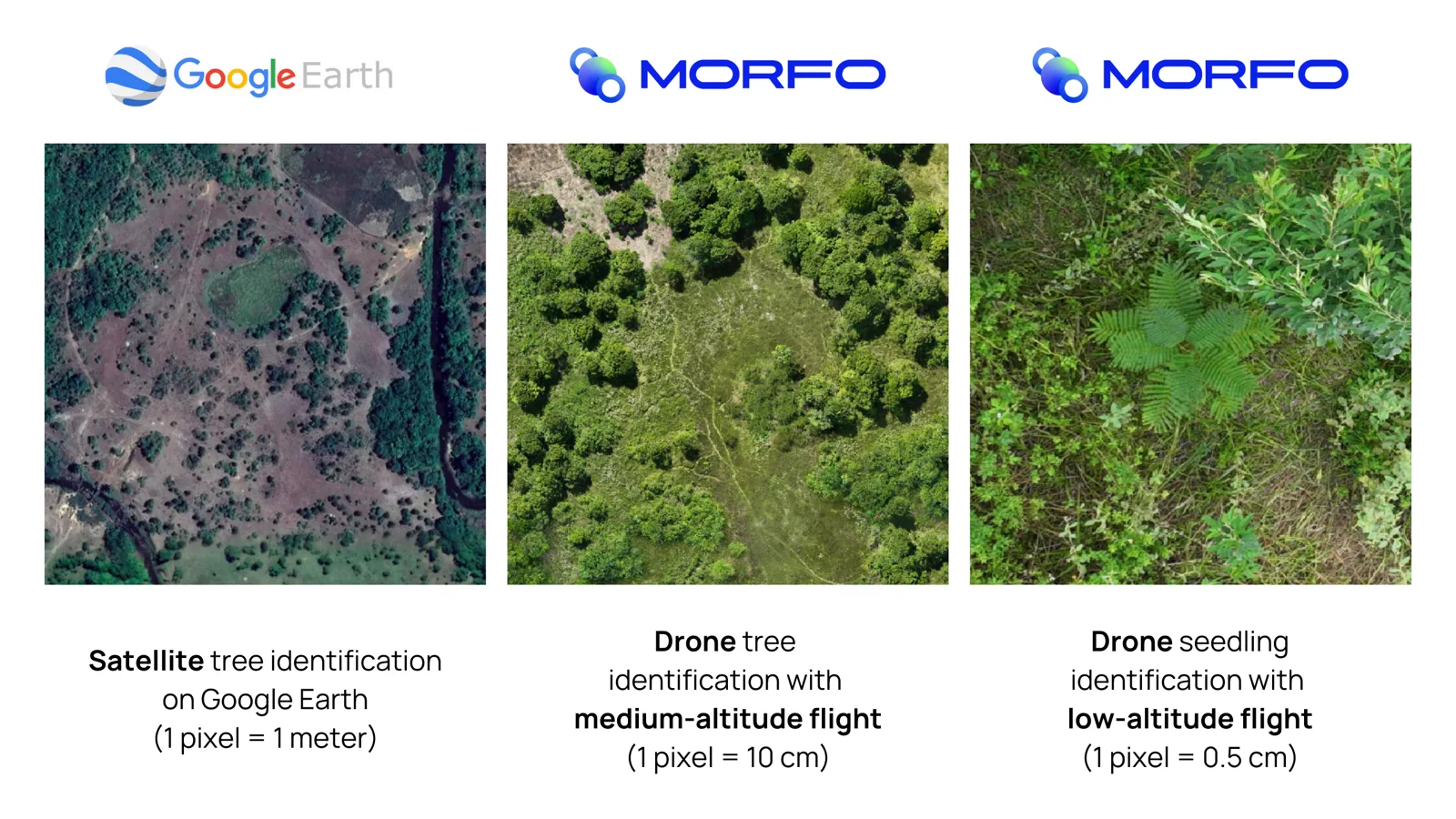 The same area read at three resolutions: satellite, drone at medium altitude, drone at low altitude. Each reading is a step on the trajectory.
Pricing the risk instead of hiding it
A contractor that takes on ecological risk has to price it. The honest way is to put the risk premium in the price and say so, rather than hide it in a margin of safety on every line. For an investor or a project developer, this changes what the money buys: a result with a ceiling, instead of a volume of activities.
The other condition is that the price adjusts to what the diagnostic finds. A contractor cannot commit to a result on land it has not read. That is why the commitment comes after the diagnostic, inside price ranges written in the contract. We wrote about the price side in four subjects that get a restoration project built in Brazil.
How MORFO splits the risk
We prescribe the plan plot by plot from the diagnostic, and we answer for the ecological result. If the forest does not grow, we replant at our own cost, over several seasons, up to a ceiling fixed in advance. The price adjusts to the diagnostic within ranges set in the contract, and beyond the ceiling we discuss with the client again. Climate, fire, third-party cattle and stoppages caused by others are named in the contract, not left to interpretation.
Every failure costs us money, so our interest is a plan that works the first time. It is a bit bold, and yes, we are taking a risk there. We take it because the plan is built from the soil and the season actually measured on the area, and because we monitor 100% of the area plot by plot, so a drift shows up in weeks rather than in year three.
If you are about to sign a restoration contract and are not sure who carries the risk in it, I would be glad to read it with you.
Frequently asked questions
Who pays for replanting when a native forest restoration fails? In most contracts the contractor replants a limited share of losses and the client pays beyond that. In a results-based contract, the contractor replants at its cost up to a ceiling fixed in advance.
Can a restoration contractor guarantee results? On the plots it prescribed after a diagnostic, yes, within a ceiling and with named exclusions. A guarantee given before anyone has read the land is either very expensive or not worth much.
What is usually excluded from a restoration guarantee? Force majeure, losses caused by the client, the landowner or third parties (cattle, fire, machinery, spraying), and areas that turned out different from what the contract described.
How is restoration success measured in a contract? Usually by seedling survival in a joint inspection a few months after planting, or by an establishment protocol for direct seeding. Better contracts add a dated trajectory of vegetation cover with ranges.
Who carries the climate risk in a restoration contract? It should be named. Waiting for the right rains is usually not counted as contractor delay, and a drought is either excluded or priced into the premium.