Degraded-pasture restoration
Google and Embrapa · Pará
From degraded pasture to dense early vegetation cover, in twelve months.
A one-hectare restoration on an Embrapa Amazonia Oriental research campus in Pará, run with Google and Embrapa. In twelve months, MORFO took degraded pasture to a dense, early-stage vegetation cover. Read it as the start of a recovery curve, not a mature forest.
- Biome
- Amazon
- Size
- 1 ha
- Status
- Cycle 1 closed, monitoring ongoing
When the team first walked the plot in April 2025, it read like much of the degraded Amazon: aggressive pasture grass holding the ground, exposed soil in places, and native forest fragments around the edges. Embrapa's laboratory found a typically Amazonian soil, acidic, sandy and low in natural fertility, which set the correction strategy before any planting. One condition matters to how the result should be read: the plot sits against mature forest, which helps seeds arrive on their own, so this is a strong signal on a single area, not proof that the same speed transfers to isolated land with no forest nearby.
MORFO ran the hectare as a full cycle, from a data read of the land to continuous monitoring, matched to a plot that sits against mature forest.
Read the land
MORFO read the hectare by drone and satellite and combined it with Embrapa's soil analysis, turning the area into data and setting the planting strategy before the first seed.
Correct the soil
Guided by the analysis, MORFO corrected and prepared the acidic, sandy soil, so planting started from a base built for the site.
Plant in two moments
MORFO planted structured seedlings of high-value native species, among them Brazil nut, Andiroba, Cupuaçu and Acapú, a species classified Endangered by CNCFlora, alongside direct seeding by drone. A later seeding reinforced slower, higher-value species under the canopy the pioneers had already formed.
Maintain and monitor
A local team trained by MORFO carried out every maintenance cycle, with specialised botanical identification and continuous monitoring of the area over time.
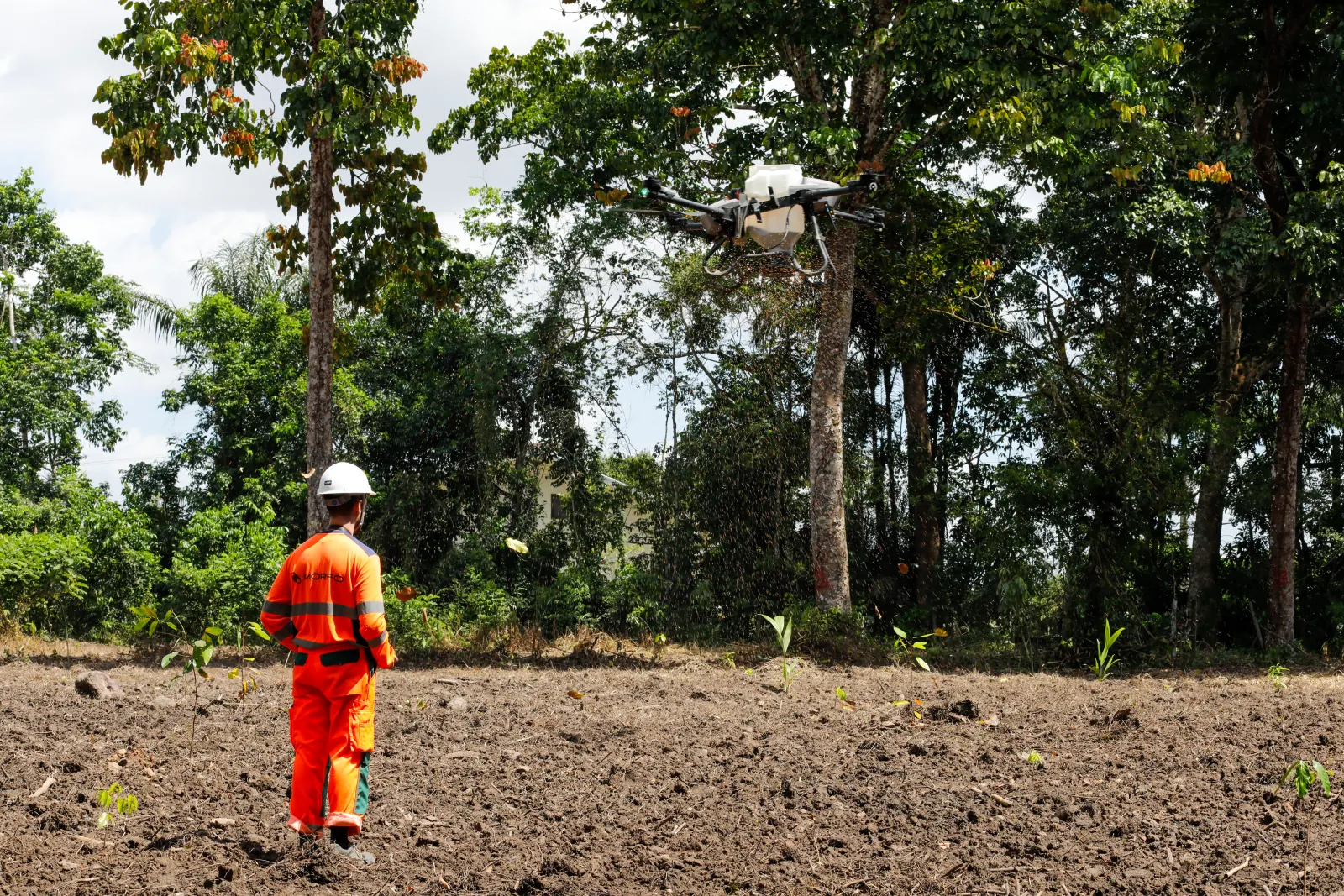
The fast cover is deliberate. By closing the canopy quickly with pioneers, MORFO builds a protective microclimate that does three things at once: it lets the high-value climax seedlings survive, it wakes the seed bank already in the soil, and it welcomes seeds carried in from the neighbouring forest by wind and wildlife. Restoration ecology calls this facilitation, or the nurse-plant effect: the pioneers that dominate the plot visually today hold the soil, suppress the invasive grass, and shelter the climax trees growing up beneath them.
Feb to Apr 2025
Diagnosis. Embrapa soil analysis and a drone and satellite read, with the planting strategy defined.
Apr to May 2025
Soil correction, structured seedlings and first aerial seeding.
Jul 2025
First monitoring at 30 days, reading seedling survival and early germination.
Oct 2025
Reinforcement seeding in the COP30 window, with later-succession species.
Apr 2026Last updated
Selective maintenance and permanent monitoring plots formalised, closing cycle 1.
The reading is honest about stage: this is the beginning of the curve, and the point is the slope, not the value on any single day.
- Ground that was degraded pasture now sits under a dense, early-stage vegetation cover.
- High-value native species are established as the structural core of the future forest, including Acapú, a species of conservation concern.
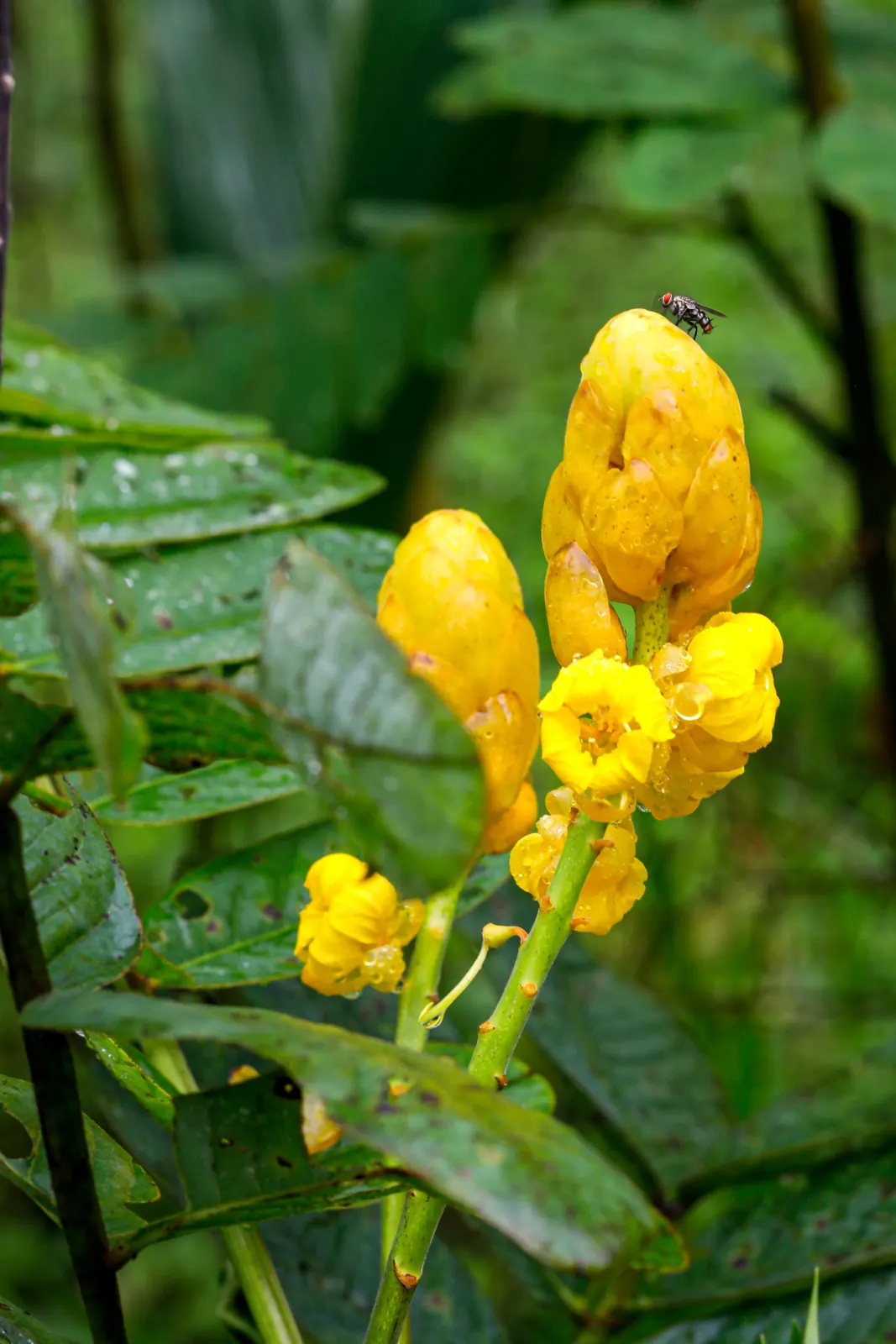
- Diversity is emerging, including species that were never planted and arrived on their own from the surrounding forest.
- Wildlife is already using the area, picked up by acoustic monitoring, a sign of use and of seeds moving in, not a population count.
Cover and carbon readings at this stage are early, sensor-based indications, to be confirmed by field inventory. The permanent plots installed at twelve months are the base for that calibration, cycle after cycle.
The area was built to be auditable and repeatable: a scientific partnership with Embrapa Amazonia Oriental, specialised botanical identification through Flora e Funga do Brasil, Species Link and CNCFlora, MORFO's monitoring dashboards for cover, carbon and diversity, permanent georeferenced plots as the basis for dendrometric measurement, and applied AI reading drone orthophotos toward automated inventory.
The area is read as early regeneration on a favourable plot, not a consolidated forest.
Run with Google and Embrapa Amazonia Oriental. Between May and November 2025 the area was hosted as a COP30 Forest Experience, with guided visits for leaders across the restoration and climate community. Every maintenance cycle was carried out by a local team trained by MORFO, creating direct jobs in the region.
- Further maintenance cycles with the local team.
- Enrichment planting under the pioneer canopy, with high-value climax species.
- A widening scientific agenda with Embrapa, and the evidence built here made ready to replicate on new sites.
This is where the method proves itself. The next step is to repeat it on land without a forest next door.
Turn degraded land into a project that holds.
Send us an area. We will tell you if it is viable, and how.