Building climate risk into a mine's PRAD and closure plan
Quentin Franque · 2026-10-30 · 8 minutes
This season, mining companies came to us through our El Niño study. None of them opened with planting. They asked first about water and rain: when the wet season would settle, how much the river would carry in the dry months, and whether the closure plan they are updating should say something about climate. Their head offices had started asking for a climate resilience plan, and the environment team was the one holding the pen.
The short answer: the PRAD and the closure plan say what must be restored, but rainfall decides when planting can take. For the 2026-27 wet season, our El Niño analysis points to rains settling two weeks or more late in ** 451 Brazilian municipalities**, and about ** 35 days late in Paragominas**, in Pará. Building climate into a PRAD means fixing, block by block, the planting window, the replanting plan and the climate factors kept outside the result commitment.
This article covers what changes in a PRAD when the wet season starts late, and what does not. It does not replace the climate study a closure plan may call for. That study looks at water balance, effluents and extreme events across the whole mine, and it is a different job from ours.
What the PRAD and the closure plan already require
In Brazil, the duty to recover land degraded by mining comes from the Federal Constitution (article 225, paragraph 2). Decree 97,632 of 1989 makes the recovery plan for degraded areas, the PRAD, part of mining licensing, and the national mining agency, ANM, regulates the mine closure plan through Resolution 68 of 2021.
These texts set what has to be recovered and how the result is checked. In what I have read, none of them asks for a climate scenario in so many words. State agencies and licence conditions add their own requirements, so the answer for a given mine sits in its own licence.
Climate still enters the PRAD through one door: the schedule. Every PRAD carries a chronogram, and every chronogram assumes a normal wet season. When head office asks for climate resilience, that chronogram is where the request becomes something an agency can check.
How late the rains could be around your mine
Our El Niño study went back over 44 past wet seasons and cut Brazil into 11,763 cells of about 28 km. It then weighted those seasons by the odds the US Climate Prediction Center (NOAA) gives for this winter's El Niño: in its October 2026 outlook, an 81% chance of a very strong event between December and February.
The result, read municipality by municipality on the El Niño 2026 page:
- Late onset. In 451 municipalities, the rains could settle two weeks or more later than usual.
- Less rain. In Paragominas, the rains settle about 35 days later and the wet season carries about 22% less rain, in the median of the scenario.
- A conservative count. A municipality without a measurable link between El Niño and its rainfall is never counted.
These are medians of a scenario with a range, not a forecast. A given season can land on either side of the median, and the page shows that range for each place.
In operational terms, the consequence is simple. If a PRAD campaign is planned for November and the rains settle in mid-December, a month of the window is gone before the first seed goes in. I wrote earlier this year about what happens when the planting window is missed: the block waits a full year.
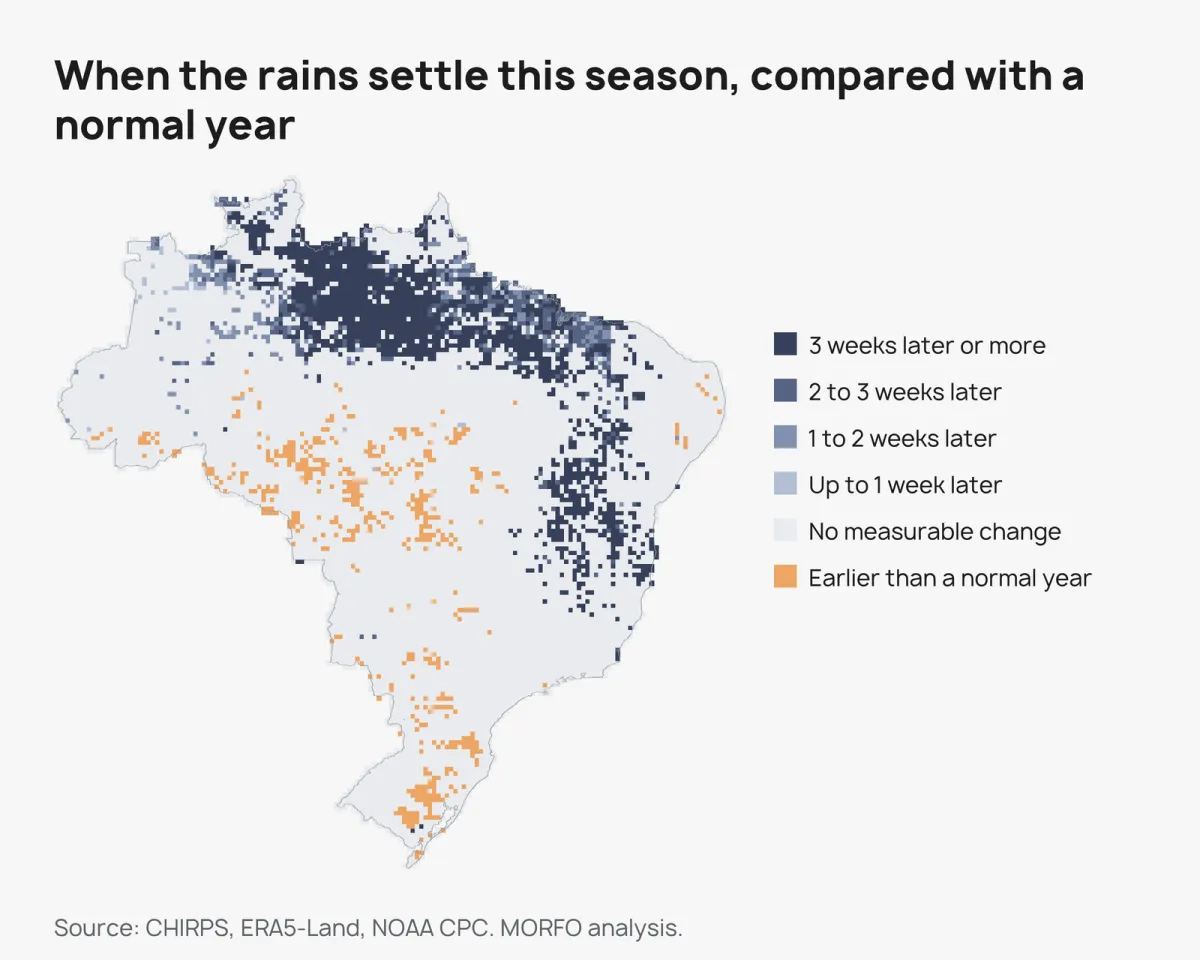 When the rains settle in the 2026-27 season compared with a normal year, median of MORFO's El Niño scenario. Source: CHIRPS, ERA5-Land, NOAA CPC, MORFO analysis.
Ordering the blocks: what goes first, what waits
A mine front is rarely one soil. On a mining project MORFO runs in Pará, the diagnostic read the ground as three scenarios: reapplied topsoil, levelled sterile, and unlevelled sterile and slopes. A large part of the front was fully exposed sterile.
That distinction set the pace. The first seeding, in April 2024, showed a limited response on bare sterile and marked the soil as the limiting factor. The second planting, in December 2024, tested soil correction on paired plots. The third campaign, in January and February 2026, put cover species and correction on the sterile first, before diversifying.
In a short wet season, I would apply the same logic to the calendar:
- Blocks with the best odds go first. Reapplied topsoil and sheltered blocks take the first weeks of a late window, because they can establish in the rain that remains.
- Blocks where soil must be built wait for their trees. On bare sterile, the window goes to correction and cover species, and trees go into the next season.
- The replanting is planned, not discovered. Each block gets a date and a budget line for a second pass if the first fails, written before the season starts.
This is an interpretation of our field experience, not a rule from the PRAD. But it turns a climate scenario into a decision the environment team can defend in front of the agency.
Slopes, piles and bare soil in a dry first quarter
The method question changes when the first quarter of the wet season is dry. Each option reacts differently to a short season:
- Hydroseeding puts fast cover on steep slopes and drainage structures, where erosion is the first risk. It needs rain soon after application.
- Direct seeding, by hand or by drone, puts more seeds on the ground at a lower cost per hectare and reaches blocks that machines cannot. On the project in Pará, correctives, seeds and capsules went down by drone, with more than 15 tonnes of inputs in one campaign.
- Seedlings give a head start where a water truck can reach the block, and they need that water when the rains are late.
The choice is made block by block, with slope, access and water as criteria (how the methods compare). On hostile mining ground, the first job is to hold the soil, not to plant a finished forest. On a former alluvial gold mine in French Guiana, MORFO's first project, the site went from bare, acidic ground to ** 81% vegetation cover in four years**, with 588 trees per hectare on average. Cover came first and the trees followed (the French Guiana project).
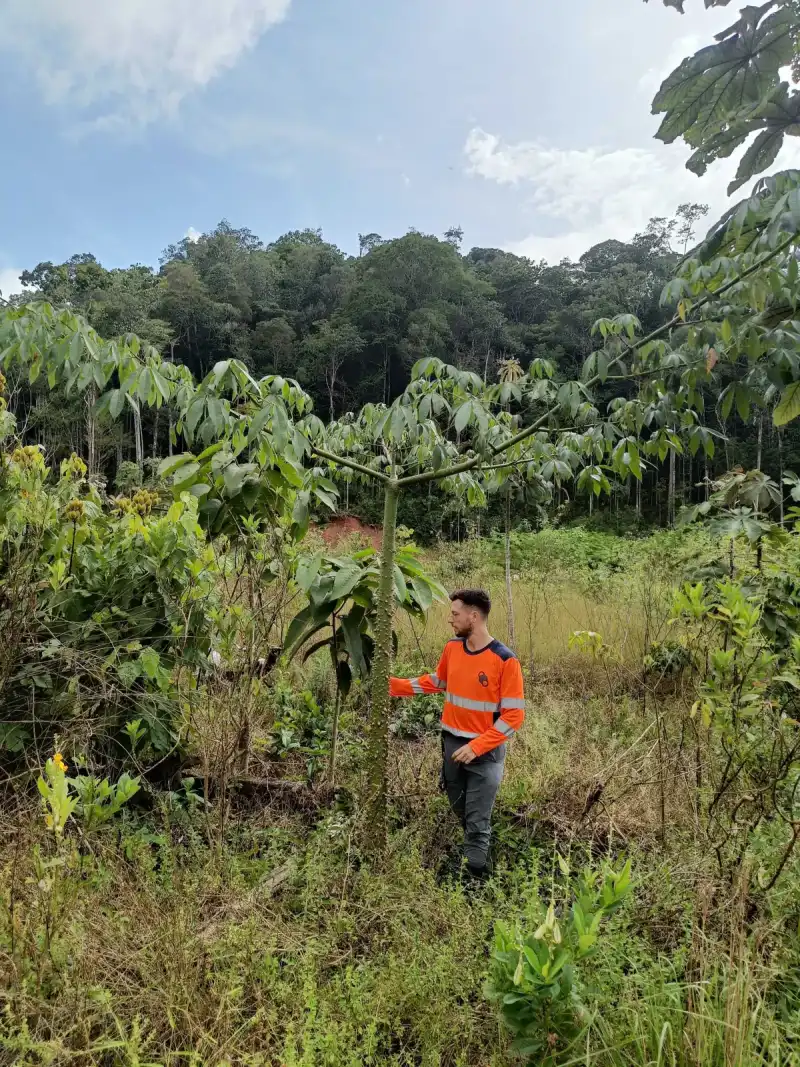 Former alluvial gold mine at Crique Korossibo, French Guiana: vegetation back on what was bare, acidic ground.
Writing a result commitment that does not carry the climate risk
A climate scenario also changes what a restoration contract should promise. Two practices hold up in a year like this one.
A dated trajectory with measurement milestones, instead of one target at a fixed date. The trajectory states the vegetation cover expected at six months, one year and two years, with a range at each step. A late season moves the first milestone. It does not void the contract.
External factors named and excluded. Climate and El Niño, fire, cattle from neighbouring land, stoppages caused by a third party. Writing that list into the contract separates what the operator controls from what nobody controls.
Excluding climate does not remove the work, though. The plan still has to say what happens when the rains are late: which blocks move, which get a second pass, and what that costs. At MORFO the position is direct: if the plan was followed and the forest did not come, that is on us. It is a risk, and we take it because the plan is built for the season actually expected, not for an average one.
What this looks like on a mining PRAD
- A calendar by block. Each talhão, our operational block, gets its window, its method and its order of entry, from the El Niño reading of its municipality and the soil reading of the block.
- The whole area monitored. Satellite on 100% of the area at each step, drone where the satellite flags something, field visits where a decision needs a sample. A block that drifts shows up in weeks, not in the third year.
- Corrective action on the block that drifted. Replanting goes where the reading says it should, not across the whole area.
That calendar is the core of the diagnostic and plan we deliver to companies under a restoration obligation.
A closure plan rarely fails on its species list. It fails on its calendar, when a campaign meets a season that did not come on time. This year, the season can be read in advance, municipality by municipality, and the PRAD that uses that reading will lose fewer blocks than the one that waits to see.
If you are updating a PRAD or a closure plan this season and the calendar is the part that worries you, I would be glad to talk about it.
Sourcing note: the mining companies mentioned at the start are not named, and their questions are reported in general terms. Rainfall figures come from MORFO's El Niño 2026 study, a scenario built on NOAA odds, not a forecast. Legal references are given for orientation and do not replace a review of each mine's licence.
Frequently asked questions
Does a PRAD have to take climate change into account? The federal texts that frame the PRAD and the closure plan do not ask for a climate scenario explicitly, in what we have read. State agencies and licence conditions can. In practice, climate enters through the chronogram, which assumes a normal wet season.
Can a mined area be planted outside the wet season? Seedlings can, with irrigation and a water truck that reaches the block. Seeds and hydroseeding need rain soon after they go down, so outside the season they carry a much higher risk of failure.
If planting fails because of drought, who is responsible? It depends on the contract. A contract that names climate as an external factor and plans a replanting window settles the question before the season. Without it, the discussion happens after the failure.
Hydroseeding, direct seeding or seedlings on a slope: how to choose? By slope, access and water. Hydroseeding holds steep slopes quickly, direct seeding reaches blocks machines cannot, seedlings suit blocks with water access. On one mine front, the three can coexist.
How much does it cost to include climate in the plan? It depends on the area, its soils and its access, so we give no figure before the diagnostic. The diagnostic delivers the calendar by block with the cost of each option.