Rehabilitating mined land in Brazil: the PRAD, the soil and the calendar
Quentin Franque · 2026-11-10 · 9 minutes
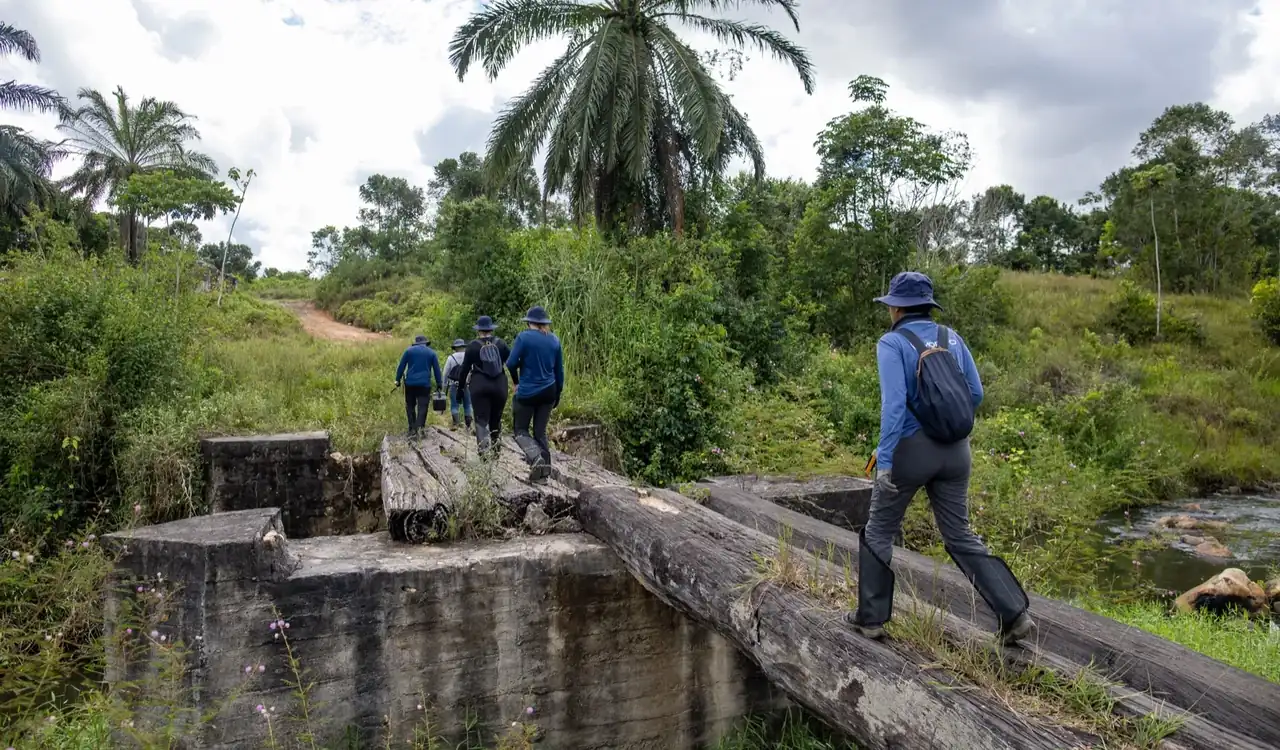
This page is for the environment team of a mining company that has to rehabilitate a mined area in Brazil: a pit, a waste pile, a tailings slope or a former front left as bare sterile. It covers what the obligation requires, how to read the ground, which method fits which block, and how long the work takes.
The short answer: a mining PRAD succeeds or fails on the soil left by the mine, so the plan has to start by reading that soil block by block, and hold it before it plants trees. On mined ground, the first years go to cover and soil correction. A forest that a regulator can accept comes after, and its pace depends on the substrate and on the wet season.
What the law requires from a mining company
The duty comes from the Federal Constitution: whoever extracts mineral resources has to recover the degraded environment (article 225, paragraph 2). Decree 97,632 of 1989 makes the recovery plan for degraded areas, the PRAD, part of mining licensing. The plan is filed with the environmental agency that licenses the mine, federal or state.
Three other texts frame the work:
- IBAMA Normative Instruction 14 of 2024 sets how a PRAD is drawn up, filed, executed and monitored at federal level. It replaced Instruction 4 of 2011 and asks for an environmental diagnostic of the area before any prescription.
- ANM Resolution 68 of 2021 regulates the mine closure plan. The PRAD is one part of that plan, not the whole of it. The national mining agency has opened a public consultation to revise this resolution, so the version in force should be checked for each filing.
- State rules and licence conditions add their own requirements: terms of reference, indicators, deadlines. For a given mine, the binding answer is in its own licence.
What these texts have in common is the logic: diagnose, prescribe, execute, monitor, and show the result. The agency does not approve a species list. It approves a trajectory and the evidence that the area is on it.
Reading the ground before choosing anything
A mine front is rarely one soil. The diagnostic separates the blocks the mine left behind, because each one calls for a different first move. On a mining project MORFO runs in Pará, the front was read as three scenarios: reapplied topsoil, levelled sterile, and unlevelled sterile with slopes.
The reading combines four sources:
- Satellite imagery over the whole area, to see vegetation, bare ground and change over time.
- Drone orthophotos, to map slopes, erosion, drainage and the edges between substrates.
- Soil sampling, analysed in a laboratory. On the project in Pará, the analysis was done with the Federal University of Viçosa and compared with a nearby mature-forest reference.
- A field visit, to check access, safety and what the images cannot show.
The sterile on that front was a hard case. It was acidic, compacted, toxic in aluminium and almost free of organic matter. On ground like that, seeds and fertiliser alone do not hold. The soil has to be corrected and covered first.
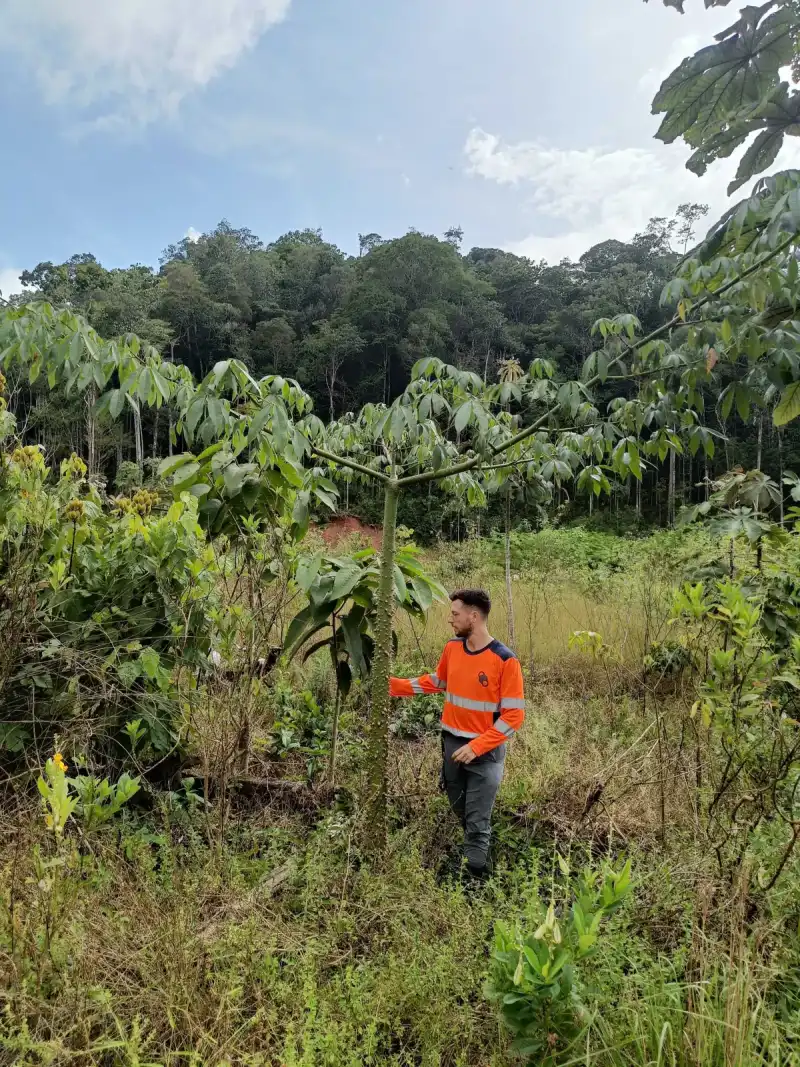 Former alluvial gold mine at Crique Korossibo, French Guiana: vegetation back on what was bare, acidic ground, four years after the first intervention.
Matching the method to each block
Once the blocks are read, the method follows from four criteria: substrate, slope, machine access and water. The table below sums up how we decide on a mine front. It is a starting grid, adjusted by the diagnostic of each area.
| Block left by the mine | First move | Method that usually fits | What to expect first |
|---|---|---|---|
| Reapplied topsoil | Plant in the first rains | Direct seeding or seedlings | Fast establishment where the topsoil is deep enough |
| Levelled sterile | Correct the soil, then cover | Liming and cover species, then direct seeding | Slow start, cover before trees |
| Unlevelled sterile and slopes | Hold the soil against erosion | Hydroseeding or seeding by drone | Cover on the slope, trees in a later season |
| Areas machines cannot reach | Reach them from the air | Seeding and correction by drone | Coverage of ground that would otherwise be left bare |
Cover species come first on bare sterile. Legumes such as Stylosanthes and Crotalaria hold the soil, add organic matter, cool the surface and keep water. Hardy native trees adapted to the substrate follow. On the project in Pará, the fava-de-bolota (Parkia platycephala) was confirmed establishing directly on the sterile.
The drone matters where the mine is active. Safety rules and terrain often keep machines off a working front. On the project in Pará, correctives, seeds and capsules went down from the air, with more than 15 tonnes of inputs in one campaign. The three methods can coexist on one front, and the choice is made block by block (how the methods compare).
How long it takes, and what slows it down
On mined ground, rehabilitation is counted in years, and the first ones look modest. The honest headline is that the substrate sets the pace. The project in Pará shows the sequence:
- January 2024, diagnostic. Three substrate scenarios defined and a technical baseline set.
- April 2024, first seeding. Limited response on bare sterile, which marked the soil as the limiting factor.
- December 2024, second planting. Liming and slow-release fertiliser tested on paired plots.
- January and February 2026, third campaign. Cover and replanting at scale, with correction of the sterile first.
- June and July 2026, closing monitoring. Cover indications converted into measured readings by strip.
Where topsoil was present, vegetation established well. On bare sterile, progress is slower and the cover-first strategy is the one that moves it. On a former alluvial gold mine in French Guiana, MORFO's first project, the site went from bare ground to 81% vegetation cover in four years, with 588 trees per hectare on average (the French Guiana project).
The other variable is the wet season. A campaign planned for November that meets rains settling in mid-December loses a month of its window, and a missed window costs a block a full year. For the 2026-27 season, our El Niño analysis points to rains settling two weeks or more late in 451 Brazilian municipalities. I wrote a separate piece on building that climate risk into a PRAD and a closure plan.
Monitoring that an agency can check
A PRAD is judged on evidence, so the monitoring plan is written at the start, not added at the end. The test is simple: could someone outside the project check the claim from the file? I went into that test in more detail in what audit-ready means for a restoration project.
On a mining PRAD, that means:
- The whole area read at each step, by satellite, with the drone where the satellite flags something and field plots where a decision needs a sample.
- Results reported block by block, so a block that drifts shows up in weeks and gets its own corrective action.
- A dated trajectory with ranges, vegetation cover expected at six months, one year and two years, instead of one target at a fixed date.
- External factors named in the contract: climate, fire, cattle from neighbouring land, stoppages caused by a third party.
What MORFO delivers on a mining PRAD
MORFO starts with a diagnostic of the area: the substrate map, the blocks, the method and calendar for each one, and the cost of each option. Execution follows the same blocks, by drone, by hand or with partners in the field, and monitoring covers the whole area at each step. The work is offered to companies under a restoration obligation, including mining companies preparing or updating a PRAD or a closure plan.
If the plan was followed and the forest did not come, that is on us. We take that risk because the plan is built from the soil and the season actually measured on the area.
Mined land does not come back on a planting schedule written for good soil. It comes back when the plan accepts that the first job is to rebuild the ground, and measures that work block by block until trees can take over.
Sourcing note: client projects are described without naming the client or sizing the area. Legal references are given for orientation, are current as of November 2026, and do not replace a review of each mine's licence.
Frequently asked questions
What is a PRAD in mining? The PRAD, or Plano de Recuperação de Áreas Degradadas, is the plan a mining company files to recover the land it degrades. Decree 97,632 of 1989 makes it part of mining licensing, and it sits inside the wider mine closure plan regulated by the ANM.
How long does it take to rehabilitate a mined area? Several years, and the pace depends on the substrate. On reapplied topsoil, vegetation can establish in the first season. On bare sterile, the first campaigns go to soil correction and cover, and trees follow in later seasons.
Can you plant trees directly on mining sterile? Rarely with success. Sterile is often acidic, compacted and poor in organic matter. It needs correction and cover species first, then hardy native trees adapted to the substrate.
Which method works on mining slopes and waste piles? Hydroseeding or seeding by drone, because they cover the slope fast and reach ground machines cannot work. Seedlings suit flatter blocks with water access. One mine front often uses all three.
How much does a mining PRAD cost? It depends on the substrate, the slope, the access and the area, so we give no figure before the diagnostic. The diagnostic delivers the method and calendar for each block with the cost of each option.