Terms of reference for a native forest restoration contract in Brazil: what to include
Quentin Franque · 2026-11-23 · 7 minutes
This page is for the procurement or environment team of a company that is about to launch a tender for native forest restoration in Brazil, for a Legal Reserve, an APP, a PRAD or a licence condition, and has to write the terms of reference.
The short answer: good terms of reference describe the area and the result expected, and leave the method to the bidder's diagnostic. They state the premises the price rests on, the indicators the agency will check, the risks each side carries, and a decision point after the diagnostic. Without these, bids cannot be compared, because each bidder is pricing a different project.
Why bids for the same area come back incomparable
This season I saw two tenders go out without technical specifications. In one of them, the bids came back with fertiliser doses that ranged from about 100 to 1,000 kg per hectare. Every bidder had to guess the soil, so every bidder priced a different site. The cheapest bid was not the most efficient one; it was the one that guessed the most optimistic soil.
When the terms of reference do not describe the land and the result, the price comparison is a comparison of assumptions. The buyer then picks on price and discovers the real project during execution.
What the terms of reference should describe
- The area. Boundaries as shapefiles, current land cover, known constraints (slope, wet areas, access in the rainy season), and the legal frame: Legal Reserve, APP, PRAD, licence condition.
- The obligation. Which agency will judge the result, under which rule and by when. The bidder needs this to design the monitoring.
- What is already known. Any soil analysis, vegetation survey or previous planting, with its results. A previous failed planting is valuable information, not something to hide.
- What the client will provide. Access, land rights, protection against cattle and fire, the client's own safety approval process and its duration.
Ask for the result, not for the method
A frequent mistake is to specify the method: so many seedlings per hectare, this spacing, this fertiliser dose. It turns the tender into a price comparison for one plan that nobody has checked against the land, and it makes the client responsible for the plan.
Ask instead for a result that the agency will accept, and let each bidder propose the method plot by plot after its own diagnostic. Ask bidders to explain how they will choose between natural regeneration, enrichment and full planting, by seeds or by seedlings, and what they will do on the plots where the first attempt fails.
The indicators to put in the contract
The indicators should be the ones the agency will use, measured on a dated trajectory rather than at one final date. São Paulo gives a public example: Resolution SMA 32 of 2014 (amended in 2020) measures three indicators, native vegetation cover, density of native regenerating plants and number of regenerating native species, with reports at 3, 5, 10, 15 and 20 years. For forest formations, the adequate level at 20 years is more than 80% cover, more than 3,000 regenerating plants per hectare and more than 30 native species. Rio de Janeiro has its own monitoring system under INEA Resolution 143 of 2017. Other states set indicators case by case, and all of these rules are updated over time, so check the version in force for each project.
- Use the state's indicators where they exist. They are what the agency will check.
- Ask for intermediate milestones with ranges. A reading at six months, one year and two years shows a drift in time to correct it.
- Ask how each indicator is measured. Sample plots, full census, imagery, or a combination, and how the client or the agency can check the data.
We wrote about what makes that evidence checkable in what audit-ready means for a restoration project.
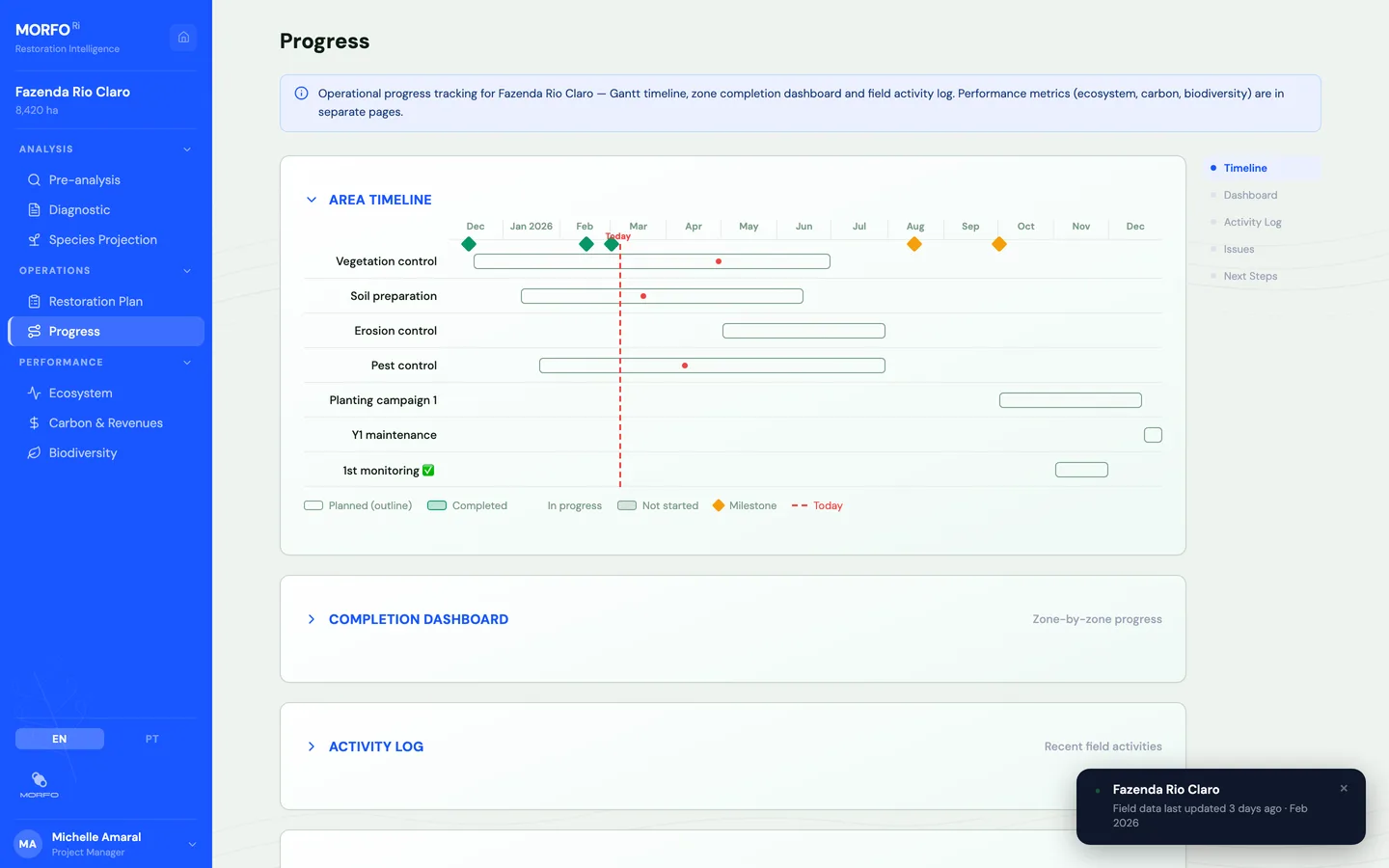 A restoration calendar with dated milestones, as tracked in MORFO Ri.
The risks to allocate in writing
- External factors. Climate, drought, fire, third-party cattle, stoppages caused by others. Name them, and say whether they are excluded or priced.
- The climate window. A delay caused by waiting for the right rains should not count as contractor delay.
- Replanting. Who replants failed plots, how many times, and up to what ceiling.
- Area different from the description. What happens if the diagnostic shows land that does not match the terms of reference.
We went into how that split works in who pays when a native forest restoration fails.
Build in a decision after the diagnostic
The terms of reference should plan for what the diagnostic will find. A structure we use in our own contracts:
- A price on written premises. The bidder states what its price assumes: access, terrain, vegetation type, logistics.
- A check of the premises. If the diagnostic shows a relevant difference, the contractor says so in writing within a fixed number of days.
- A decision. The parties adjust price and calendar within ranges set in the contract, or stop before implementation without penalty.
- A binding calendar set by the diagnostic. The calendar in the proposal is indicative; the one approved at the end of the diagnostic is the one that counts.
This protects the buyer as much as the contractor. The price that goes into execution has been checked against the land.
How MORFO answers a tender
When a buyer asks, we help write the technical part of the terms of reference, and we then answer the tender like any other bidder. Our answer starts from a diagnostic of the area and prescribes the method plot by plot. We answer for the ecological result: if the plan was followed and the forest did not grow, we replant at our own cost up to a ceiling fixed in advance, with a price that adjusts to the diagnostic within ranges written in the contract.
Terms of reference are where most of a project's risk is decided, months before anyone plants. If you are writing one, I would be glad to read it with you.
Frequently asked questions
What should terms of reference for forest restoration include? The area and its constraints, the legal obligation and the agency, what is already known, what the client provides, the indicators and milestones, the allocation of risks and a decision point after the diagnostic.
Should the terms of reference specify the planting method? Preferably not. Specify the result the agency must accept and let bidders propose the method plot by plot from their diagnostic.
Which indicators are used to judge native forest restoration in Brazil? It depends on the state. São Paulo's SMA 32/2014 uses native vegetation cover, density of native regenerating plants and number of native species, with reference values from 3 to 20 years.
How can restoration bids be compared? Ask every bidder for its premises, its method by type of plot, its indicators and its replanting commitment. Compare total cost until the agency accepts the area, not price at signature.
What happens if the area differs from the terms of reference? A good contract plans for it: written notice after the diagnostic, then adjustment of price and calendar within set ranges, or a stop without penalty.