Who restores native forests in Brazil: NGOs, alliances, research, seed networks and project developers
Quentin Franque · 2026-11-26 · 12 minutes
This page is for a landowner, a company with a restoration obligation or a fund that wants to restore native forest in Brazil and is asking who does what. It is written by MORFO, which is one of the companies described here. For every other organisation, we only say what its own website states, as read in November 2026. There is no ranking: the order inside each section is not a preference.
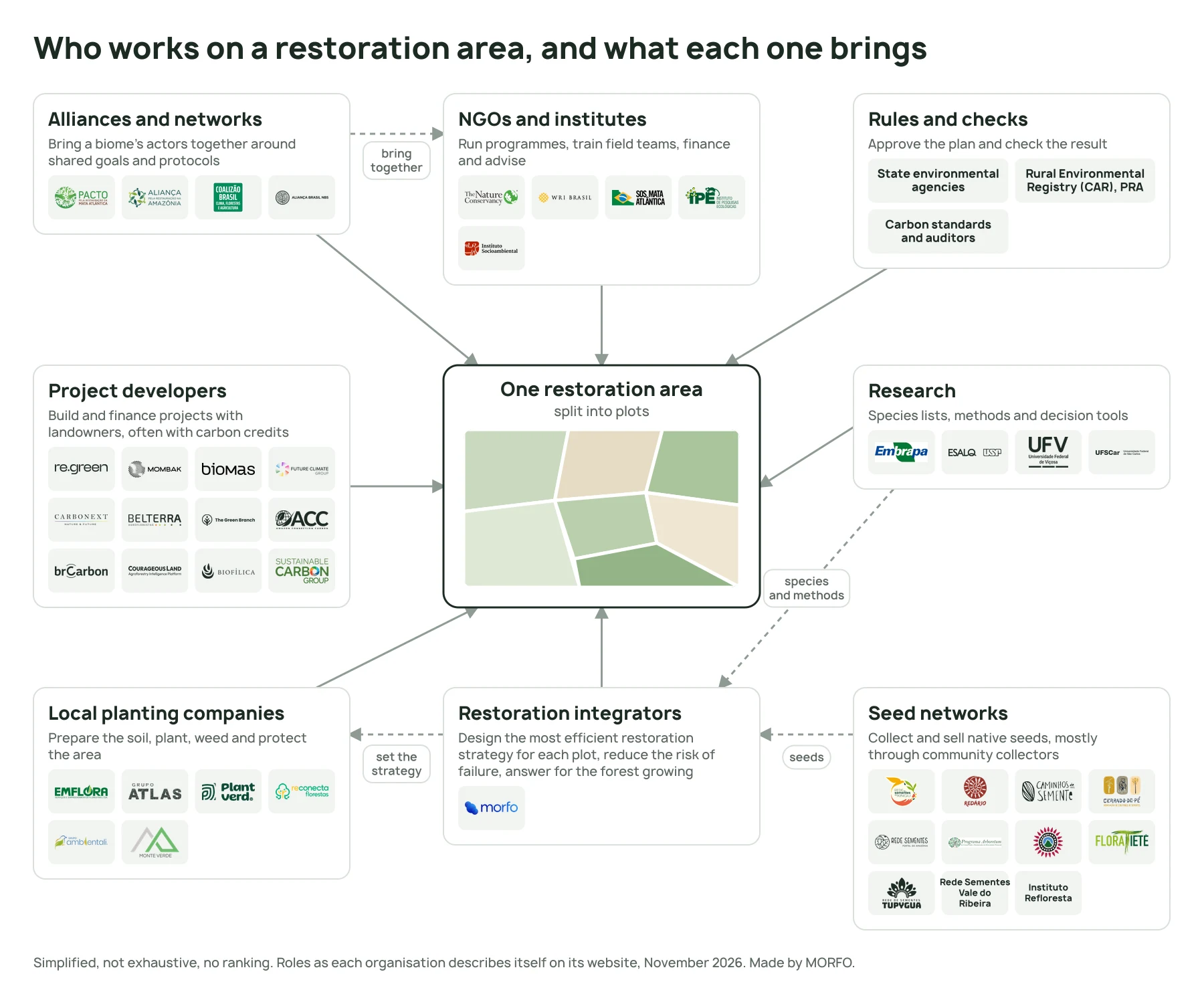
The short answer: native forest restoration in Brazil is carried by six kinds of actors. Alliances set shared goals and protocols for a biome or a market (Pacto pela Restauração da Mata Atlântica, Aliança pela Restauração na Amazônia, Coalizão Brasil, NBS Brazil Alliance). NGOs and institutes run programmes, train and advise (TNC Brasil, WRI Brasil, SOS Mata Atlântica, IPÊ). Research produces species lists, methods and tools (Embrapa, universities such as ESALQ/USP, UFV and UFSCar). Seed networks collect and sell native seeds (Rede de Sementes do Xingu, Redário, Cerrado de Pé and many more). Local planting companies do the field work: soil, planting, weeding, fire protection (Emflora, Atlas Florestal and others). Project developers build and finance projects, often with carbon credits (re.green, Mombak, Biomas, Future Climate, The Green Branch and others). Who to call depends on what you need: partners and protocols, a programme, a method, seeds, a field team, or a project built and financed.
How this map was built
We started from the published member directories of three alliances, because they are the closest thing to a list of who is active:
- Pacto pela Restauração da Mata Atlântica. Its member directory classifies members by type (company, NGO, government, research centre, association) and by role in the chain, such as services and inputs, seedlings, or execution. The Pacto states more than 340 members.
- Aliança pela Restauração na Amazônia. Its member pages sort members into five groups: academia, companies, government institutions, civil society organisations, and Indigenous peoples, traditional communities and family farmers. MORFO is listed among the companies.
- NBS Brazil Alliance. Its members page lists the associated carbon project developers, third-sector organisations and impact investors working on nature-based solutions.
We then read each organisation's own website and kept only what it says it does. One published study maps restoration actors in a structured way: Atores da Restauração na Amazônia, by WRI Brasil, Ipam and IIS with the Aliança pela Restauração na Amazônia (2025). According to the press coverage of the study, it identified 187 actors and 348 connections in the Amazon and analysed four networks: technical information, inputs and materials, monitoring, and financing. We did not find an equivalent national typology. If you know one, we would like to read it.
Alliances and networks
Alliances do not restore land themselves. They bring together the organisations that do, set shared targets, and publish protocols that the whole sector can use.
Pacto pela Restauração da Mata Atlântica. A national movement created in April 2009 to articulate restoration actors in the Atlantic Forest, with a goal of 15 million hectares by 2050. It states more than 340 members, 23 regional units and working groups, and it is a chapter of SOBRE, the Brazilian Society for Ecological Restoration. Its current lines of work include certified territories, training and multidimensional monitoring. Call it when your area is in the Atlantic Forest and you want to find partners, nurseries or service providers in your region, or to use its monitoring protocol.
Aliança pela Restauração na Amazônia. A multi-institutional initiative established in 2017 to articulate the actors of restoration in the Amazon, integrated with conservation. It publishes technical recommendations and monitoring indicators, and it is also a chapter of SOBRE. Its board brings together government, companies, NGOs and research institutions. Call it when your project is in the Amazon and you want the region's technical references or partners from academia, communities or companies.
Coalizão Brasil Clima, Florestas e Agricultura. A movement founded in 2015 that gathers more than 400 representatives of the private sector, finance, academia and civil society. It works on public policy proposals, including the recovery of degraded areas, and launched the Observatório da Restauração, a data platform on the recovery of native vegetation in Brazil's six biomes. Call it when you need the policy context or national data on where restoration is happening.
NBS Brazil Alliance. An association of carbon project developers, third-sector organisations and impact investors working on nature-based solutions. Its members page lists, among others, ACX, Agrocortex, Biofílica, Biomas, BR Carbon, Carbonext, Equitable Earth, Mombak, re.green, Systemica and Wildlife Works. It organises the Brazilian Climate and Carbon Conference, held in São Paulo in August 2026. Call it when you are looking at carbon finance for restoration and want to know who develops projects.
NGOs and institutes
These organisations run their own restoration programmes, often with landowners and companies, and train the people who do the work.
TNC Brasil. The Nature Conservancy has worked on restoration in Brazil since 2001. In 2018 it created Restaura Brasil, a programme to mobilise political actors, companies and society around the national goal of restoring 12 million hectares by 2030, and it states that it has promoted 106 thousand hectares with its partners. It works in the Amazon, the Cerrado and the Atlantic Forest, with rural producers, companies and training for professionals. Call it when a company wants to fund a structured programme with rural producers, or when a team needs training.
WRI Brasil. Supports practices and public policies for landscape restoration and runs local projects in the Amazon, the Caatinga and the Atlantic Forest, including assisted natural regeneration at scale in the Amazon and the Raízes da Caatinga programme. It also publishes analyses of the economics of restoration. Call it when you work with public policy or a municipality, or need data on the restoration economy.
SOS Mata Atlântica. Its Florestas do Futuro programme, running since 2004, restores the Atlantic Forest with companies, landowners and public authorities, with a focus on springs and riverbanks. The programme page states around 40 million seedlings planted on about 23,000 hectares. Call it when a company wants to fund Atlantic Forest restoration, voluntary or as legal compensation.
IPÊ, Instituto de Pesquisas Ecológicas. Since 2000, its Corredores de Vida project in the Pontal do Paranapanema, in São Paulo state, has planted more than 12 million native trees on about 7,000 hectares. Other projects work on water in the Cantareira region, on APP and Legal Reserve with producers in southern Bahia, and on agroforestry in the lower Rio Negro. Call it when you have land or a programme in one of these regions.
Research
Research institutions produce what everyone else uses: species lists by region, planting methods, and decision tools.
Embrapa. Brazil's agricultural research corporation runs WebAmbiente, a free decision-support system for bringing a rural property into environmental compliance. Embrapa describes it as Brazil's largest database of native species for vegetation recovery, organised by biome. Call it when you need to choose species and methods for a property, or want a scientific partner for a research programme.
Universities. Many Brazilian universities run restoration research. At ESALQ, the agriculture school of the University of São Paulo, the LERF laboratory describes itself as an international reference in the study, teaching, conservation and restoration of tropical forests. The Federal University of Viçosa (UFV) and the Federal University of São Carlos (UFSCar) are two of the universities MORFO runs research programmes with. Call them when you need a scientific partner, a monitoring protocol reviewed, or a team trained.
Seed networks
Native seeds are the input that most often limits a restoration project, because they are collected by hand, species by species, in a fixed season. Seed networks organise that collection, most of the time with community collectors.
Rede de Sementes do Xingu. Created in 2007 with the Instituto Socioambiental, it collects and sells native seeds in the Xingu, Araguaia and Teles Pires region, in Mato Grosso. It states more than 700 collectors from Indigenous peoples, family farming settlements and urban groups, about 80% of them women, 415 tonnes of seeds sold and more than 11,500 hectares restored. It is known for muvuca, a direct seeding mix of 40 to 80 species. Call it when you plan direct seeding in its region; it publishes a yearly catalogue and takes planned orders.
Redário. Since 2022, Redário has connected networks of native seed collectors, most of them community-based: Indigenous, quilombola, geraizeiro and smallholder groups. Its site states 27 networks in 11 states and the Federal District. Call it when you need seeds from several regions or a supplier outside your area.
Caminhos da Semente. A network that works to scale up restoration by direct seeding, coordinated by Agroicone with the Instituto Socioambiental and Embrapa. Its site offers a map of plantings, demonstration areas, a directory of seed networks and service providers, and a technical library. Call it when you are considering direct seeding for the first time and want to see an example near you or find a provider.
More seed networks, each described from its own site or its partner's:
- Associação Cerrado de Pé, Chapada dos Veadeiros, Goiás. Seed collectors who also carry out Cerrado restoration. Its site states 70 tonnes of seeds collected, 240 families and 120 species.
- Rede Sementes do Portal da Amazônia, northern Mato Grosso. Born in 2010 from a project of the Instituto Ouro Verde, with 14 seed houses in the municipalities it covers.
- Programa Arboretum, southern Bahia. Conserves and restores Atlantic Forest tree diversity; its seed network brings together more than 40 collectors from seven traditional communities, with a seed laboratory.
- Coopajé, Porto Seguro, Bahia. The native seed collectors' network of a reforestation cooperative in the Pataxó village of Boca da Mata.
- Rede de Sementes Tupyguá, Aracruz, Espírito Santo. A network of Indigenous seed collectors.
- Flora do Tietê, Penápolis, São Paulo. A forest recovery association working since 1986 that sells native seedlings and seeds and carries out reforestation.
- Instituto Refloresta, São Paulo state. Produces native seeds with its own team from about 3,000 registered mother trees of 110 species.
- Rede de Sementes do Vale do Ribeira, São Paulo. Quilombola collectors from four communities; in 2022 the Instituto Socioambiental reported 42 collectors and 2.6 tonnes of seeds collected since 2017.
The Caminhos da Semente directory lists 26 networks in total, from the Amazon to the Atlantic Forest, which is the best place to find collectors close to your area.
Local planting companies
These are the companies whose teams are on the ground: they prepare the soil, plant seedlings or sow seeds, weed, build fire breaks and maintain the area for the first years. Most projects, whoever designs or finances them, depend on one of them.
Emflora. A forestry services company working since 1991, with its own nursery, planting and maintenance teams in nine states. Its site states 63,000 hectares planted in 2025 and lists restoration and carbon work in Pará. Call it when a project needs field capacity at large scale.
Atlas Florestal. Plants native species and restores APP and Legal Reserve areas with its own teams, and runs a native seedling nursery for the Atlantic Forest. Its site states more than 500 hectares of restoration and agroforestry implemented or under way since 2019, in more than six states. Call it when you need APP or Legal Reserve recomposition carried out.
Plantverd. Runs ecosystem restoration projects with native seedlings for companies that need to meet environmental obligations. Call it when a company in the Atlantic Forest needs a planting partner.
Reconecta Florestas. Provides technical advice and services in conservation and ecological restoration: managing and carrying out restoration projects, running native seedling nurseries, and environmental licensing. It states more than 15 years of experience. Call it when you need both the technical project and its execution.
Grupo Ambientali. Its reforestation line plants native seedlings, recovers degraded areas and carries out ecological restoration, alongside environmental licensing. Call it when a restoration obligation comes with a licensing process.
Monte Verde. Based in Itajubá, Minas Gerais, it promotes forest restoration and carbon capture. Call it when you have a project in southern Minas Gerais.
The Pacto pela Restauração da Mata Atlântica lists about forty more companies whose role is execution, which is the best place to find a team close to your area.
Project developers and restoration companies
Project developers build restoration projects and find the money for them, often through carbon credits sold to companies. Their models differ: some work on land they manage directly, others partner with landowners, and some focus on forest conservation rather than restoration.
re.green. Restores degraded land at scale in the Amazon and the Atlantic Forest. Its site states 100 thousand hectares under management, of which 30 thousand are in active restoration, and carbon credits issued from native restoration. It runs its own nursery and offers projects and partnerships with companies. Call it when a company wants a long-term restoration partnership at large scale.
Mombak. Describes itself as a carbon removal company. Through afforestation, reforestation and revegetation (ARR), it reforests the Amazon with a diversity of native species and creates jobs in local communities. It also works on enhanced rock weathering and manages investment funds. Call it when a company wants to buy carbon removals from Amazon reforestation.
Biomas. A large-scale ecological restoration business created in 2022 by six large companies and banks, with the stated aim of restoring and protecting 4 million hectares of native forest over 20 years. It identifies areas, plans, plants native trees, monitors, and generates and sells carbon removal credits, working with local communities. Call it when a company wants removal credits from native restoration.
Future Climate Group. A climate company with five lines: climate education, consulting, nature-based carbon projects, energy carbon projects and carbon trading. One of its projects in Mato Grosso combines native reforestation and natural regeneration. Call it when a company needs a carbon strategy from advice to credits.
Carbonext. Develops nature-based solutions focused on forest conservation and carbon credits in the Amazon. It offers services to companies, and to landowners who want carbon income from a standing forest. Call it when you own forest that you want to keep standing and finance through carbon.
Belterra Agroflorestas. Partners with small and medium farmers to create productive forests on degraded land, with short-cycle crops from the first year. Its technical team prepares the soil, supplies inputs and plants. Call it when a farmer wants restoration that also produces income.
The Green Branch. An Amsterdam-based developer of certified nature-based carbon removal projects in the global south, working with local operational partners. In Brazil its portfolio includes a certified reforestation project in Bahia (VCS and CCB), Trees for Farmers in Mato Grosso and the Samauma project in Pará. It co-develops projects with NGOs and other developers, sells removals to companies, structures investments in land for reforestation, and advises companies and landowners. It states a goal of 100,000 hectares restored and protected before 2035. Call it when an NGO or a developer needs a partner to take a project through carbon certification, or a company wants to buy removals.
Amazon Connection Carbon. A company rooted in the Amazon that develops REDD+, reforestation (ARR) and other nature-based carbon projects, working with local communities and Indigenous peoples. Its flagship project protects the Xikrin do Cateté Indigenous territory in Pará, and it built Forestia, an eligibility analysis platform for carbon projects, with the Federal Rural University of the Amazon (UFRA). Call it when you own forest or represent a community in the Amazon and want to assess its carbon potential.
BR Carbon. Develops conservation (REDD+), ecological restoration (ARR) and sustainable agriculture carbon projects. Its two restoration projects are in Bahia and in the Cerrado, the second one combining reforestation with the environmental compliance of rural properties. Call it when a landowner wants restoration financed through carbon.
Courageous Land. Helps farmers turn their land into a profitable source of agroforestry products and carbon, and states more than 1,000 farms. Call it when a farmer wants trees that produce income and carbon.
Other carbon developers active in Brazil, such as Biofílica and Sustainable Carbon, work mainly on keeping standing forest protected (REDD+); Biofílica also offers Legal Reserve compensation.
The alliance directories list many more developers, such as Symbiosis Investimentos and Systemica in the Atlantic Forest and the Amazon.
One project, step by step
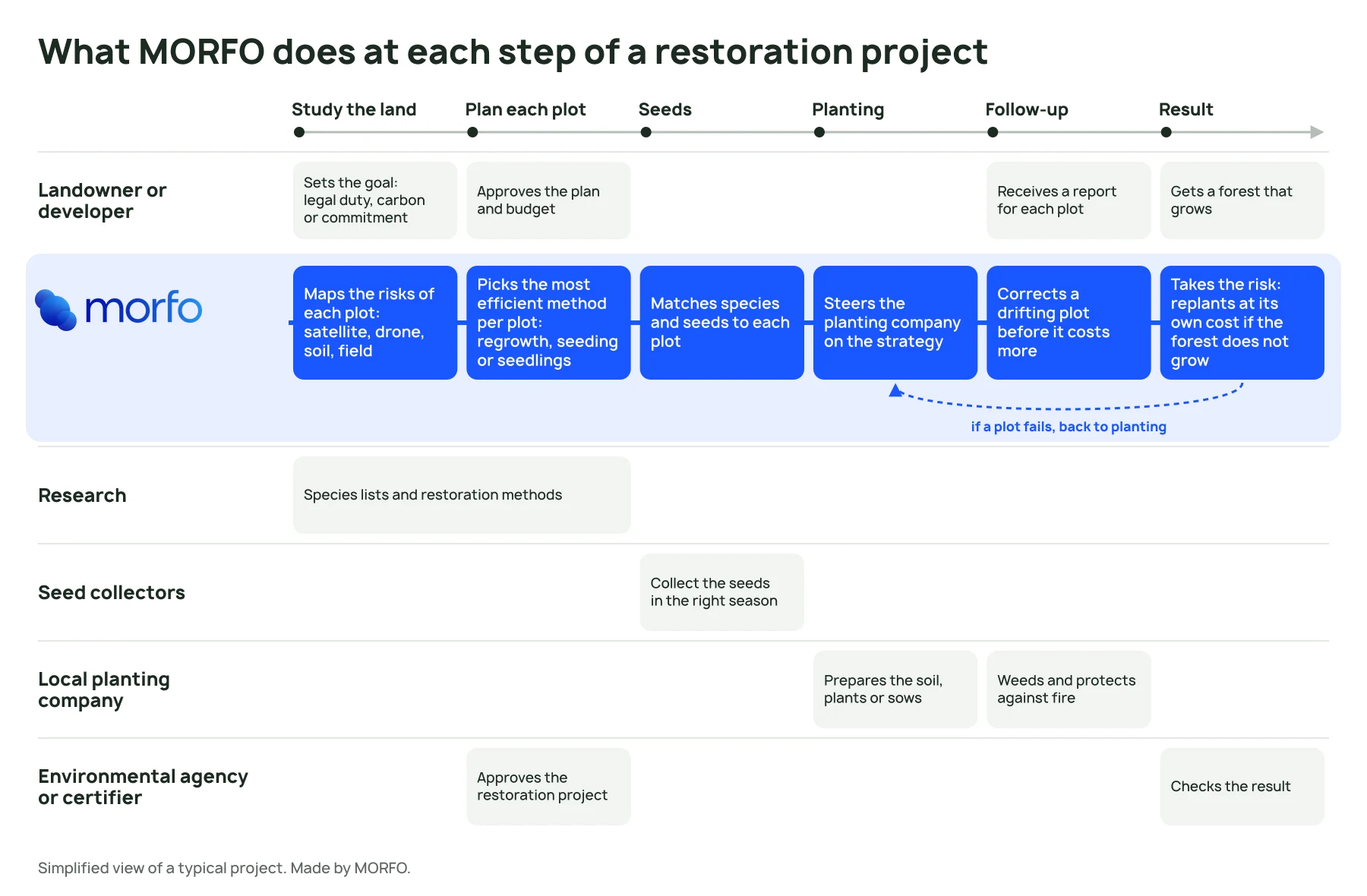
No single organisation restores a forest alone. On a typical project, the owner of the area sets the goal and pays, someone writes the plan, seed networks supply the seeds, a planting company does the field work, and an environmental agency or an auditor checks the result. Alliances, NGOs and research work around all projects: they set the rules, train the teams and provide the species lists. The diagram below follows one project from the study of the land to the result, with what MORFO does at each step.
MORFO: we design the restoration strategy and answer for the forest growing
This part is about us, MORFO, a Franco-Brazilian company. In one sentence: we design the most efficient restoration strategy for each piece of land, we reduce the risk that it fails, and we pay to replant if the forest does not grow.
- Before planting, we study the land. Satellite images, drone flights, soil samples and a field visit. Two plots side by side can need very different things: one only needs protection so the forest comes back on its own, the next one needs its soil prepared and trees planted. We write a plan for each plot, with the species to use and what it will cost (what the field diagnostic measures).
- During the work, we follow every plot. A local planting company does the field work, and we check each plot. If one goes wrong, we fix that plot instead of redoing the whole area.
- We supply the native seeds. Our seed chain is registered with the Ministry of Agriculture, we have catalogued 490 native species, and about 1,500 collectors work with us.
- If the plan was followed and the forest did not grow, we replant at our own cost, up to a limit agreed before the contract is signed.
We do not own land and we do not sell carbon credits. We work for whoever holds the area: a company with an obligation to restore, a project developer or a fund. On large projects we team up with an established planting company: it brings the field capacity, we bring the plan and take responsibility for the ecological result. Today we manage 2,142 hectares in three Brazilian biomes and in French Guiana, and we are a member of the Aliança pela Restauração na Amazônia (how MORFO works).
Frequently asked questions
Who restores native forests in Brazil? Six kinds of actors: alliances that set goals and protocols, NGOs and institutes that run programmes, research institutions, seed networks, local planting companies, and project developers. They usually work together on the same project: an owner or a developer pays, a seed network supplies the seeds, a planting company does the field work, and an agency or an auditor checks the result.
Which companies do native forest restoration in Brazil? Planting companies such as Emflora, Atlas Florestal or Reconecta Florestas carry out the field work. Project developers such as re.green, Mombak and Biomas restore at scale and finance it through carbon credits. MORFO plans the restoration of each plot for the owner of an area and answers for the result. The member lists of the Pacto pela Restauração da Mata Atlântica and the Aliança pela Restauração na Amazônia name many more.
Where can I buy native seeds for restoration in Brazil? From seed networks such as the Rede de Sementes do Xingu, from the networks connected by Redário, or from suppliers listed in the Caminhos da Semente directory. Check that the supplier is registered in RENASEM and ask for species, volumes and collection calendar before signing hectares.
Is there an official list of restoration actors in Brazil? We did not find a national one. The closest are the member directories of the Pacto (Atlantic Forest), the Aliança (Amazon) and the NBS Brazil Alliance (carbon developers), and the 2025 WRI Brasil, Ipam and IIS study of 187 actors in the Amazon.
What does MORFO do? MORFO studies the land, chooses the most efficient restoration strategy for each plot to reduce cost and risk, organises the planting company and the seeds, and follows every plot. If the plan was followed and the forest did not grow, it replants at its own cost, up to a limit agreed in advance. It does not own land or sell carbon credits.
Related
- The field diagnostic before a native forest restoration project: what is measured and what you get
- Recomposing APP and Legal Reserve in Brazil: what the Forest Code requires, PRA, PRADA, deadlines and proof
- Direct seeding or native seedlings to restore a Legal Reserve, and what to do when seeds arrive late