Direct seeding or native seedlings to restore a Legal Reserve, and what to do when seeds arrive late
Luisa Ritzmann Peceniski · 2026-11-23 · 8 minutes

This page is for a landowner or a company that has to recompose a Legal Reserve in Brazil and is choosing between sowing native seeds directly and planting nursery seedlings.
The short answer: direct seeding suits plots with workable soil, controllable grass and a reliable seed supply, and seedlings suit plots where each plant has to survive strong competition or where seeds will not arrive in time. Most Legal Reserves end up with both, chosen plot by plot. The method matters less than the timing: seeds sown after the rains have settled lose a large part of their season.
What the law allows for a Legal Reserve
The Forest Code (Law 12,651 of 2012, article 66) lets a landowner regularise a Legal Reserve deficit by recomposition, natural regeneration or compensation, alone or combined. Recomposition can mix native species with exotic ones, the exotics limited to half of the area to recover. The law does not choose between seeds and seedlings. The method is a technical choice, and the agency judges the result, not the technique. State rules and the landowner's Environmental Regularisation Programme (PRA) terms set the indicators and deadlines, and they change over time, so they have to be checked for each project.
Direct seeding and seedlings, side by side
Direct seeding means sowing a mix of native seeds, often trees together with fast cover species, straight into prepared soil. In Brazil the best-known version is the muvuca, a dense mix sown by hand or machine. Seedlings are young plants raised in a nursery and planted one by one.
- Density. Direct seeding puts far more individuals per hectare in the ground, and lets the site select the ones that establish. Seedlings put fewer plants, each one with a better start.
- Cost structure. Seeds are cheaper to transport and sow than seedlings are to raise and plant, but direct seeding needs more seed per hectare and good soil preparation. In a cost comparison by Embrapa with two federal universities, manual direct seeding cost less than half as much per hectare as seedling planting; the Instituto Socioambiental reports muvuca up to three times cheaper than seedlings.
- Competition. Seedlings stand above invasive grass from day one. Seeds germinate under it, so grass control before and after sowing decides the outcome.
- Species. Some native species establish well from seed, others almost never do and need a nursery. A good mix uses each method for the species it suits.
- Calendar. Seeds have to be collected in their own season and sown at the start of the rains. Seedlings need months in a nursery, which has to be ordered well ahead.
Which native species establish well from seed is a research question in its own right. We work on it with the Federal University of São Carlos (UFSCar).
Choosing plot by plot
On one Legal Reserve, plots can differ enough to need both. These are the questions we ask for each plot:
- Is the soil workable? Direct seeding needs soil that can be prepared and that holds water near the surface. Very compacted or very sandy ground often calls for seedlings or for soil work first.
- How strong is the grass? Under dense brachiaria, sown seeds struggle unless the grass is controlled. Where herbicide is not allowed, this weighs heavily toward seedlings or toward a longer preparation.
- Is there natural regrowth? A plot with an active bank of native seedlings may need protection and enrichment, not a full planting. We wrote about measuring that first in natural regeneration in a Legal Reserve.
- Will the seeds arrive in time? If the right species and volumes cannot be secured before the rains, the plan has to change.
The broader comparison of methods, including drones and hydroseeding, is in comparing reforestation methods.
When seeds arrive late
This is the case we were asked about this season. A contractor recommended direct seeding for a Legal Reserve, but the native seeds might only arrive in January or February, well after the rains had started. Sowing that late shortens the first growing season, and seedlings that germinate late face the dry months with shallow roots.
There are a few honest options when this happens:
- Split the area. Plant seedlings this season on the plots that cannot wait, and keep direct seeding for the plots where the seeds will be ready next season.
- Sow what is ready. Start with the cover species and the trees whose seeds are already in stock, and enrich later.
- Prepare now, sow next season. Use this season to control grass and work the soil, so that next season's seeding starts on better ground.
- Move the calendar openly. If the whole area depends on late seeds, say so in the plan and in the contract rather than sowing into the end of the rains.
Which option is right depends on the deadline the landowner faces with the agency and on how much of the area can wait.
In that case, the decision was to plant seedlings over the whole area this season and to keep direct seeding on one hectare, about 5% of the area, as a control plot. The control plot will show within six months how direct seeding performs on that soil, and the comparison will decide whether to use it on a much larger area later, at lower cost.
The seed chain is the critical path
Direct seeding is only as reliable as the seeds behind it. In Brazil, the trade in seeds is regulated by the National Seed and Seedling System, with registration in the national registry, RENASEM (Decree 10,586 of 2020). Producers, collectors and traders have to be registered or accredited, with exemptions for family farmers and their associations. A buyer of native seeds should check who in the chain is registered, because the agency or a certifier may ask for the origin of the seeds.
Before we commit to a seeding plan on a set of hectares, we check the volume and lead time our seed network can actually supply. We work with a RENASEM-registered chain and have catalogued 490 native species, with 30 to 40 key species for each of the three biomes in Brazil where we work, and a collection network of about 1,500 people.
Seeds and seedlings also work together. On a one-hectare research plot we ran with Google and Embrapa, on degraded pasture, we planted seedlings of high-value native species and sowed pioneers by drone around them. Twelve months later the pasture was under a dense early vegetation cover, the start of a recovery that monitoring will follow (the project).
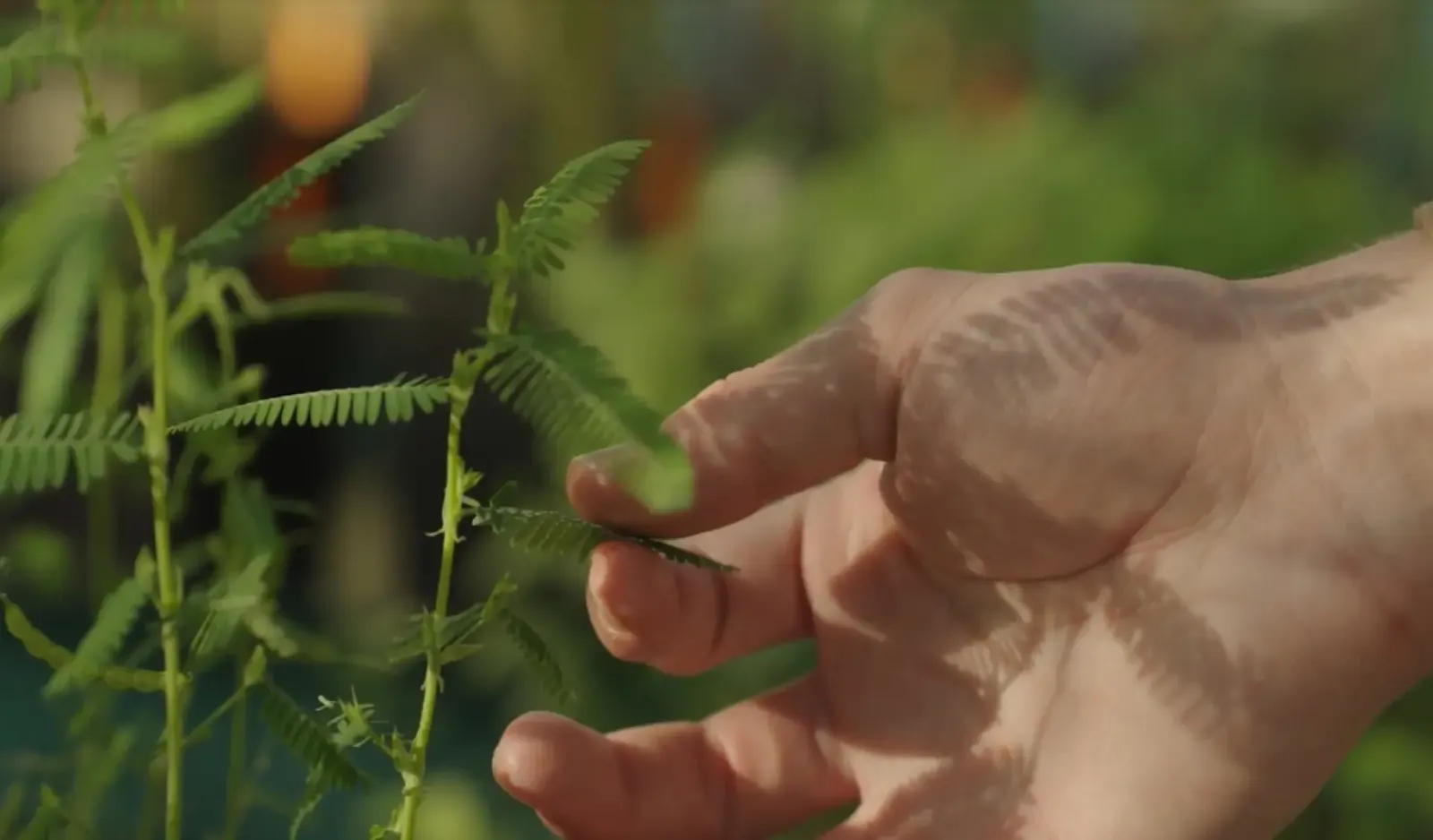 A young native plant checked in the field. Which species establish from seed is decided before the mix is sown.
How MORFO decides
We prescribe the method plot by plot from the diagnostic: direct seeding where soil, grass and seed supply allow it, seedlings where each plant needs a head start, and protection where the land is already regrowing. For direct seeding, the success criterion is written in a protocol agreed with the client before implementation, with an establishment rate and an evaluation date suited to the species and the method. Seed and seedling volumes are checked before the plan is signed, so the calendar we commit to is one we can supply.
The choice between seeds and seedlings is rarely a matter of principle. It is a matter of what each plot needs and what can arrive before the rains.
Frequently asked questions
Can a Legal Reserve be restored by direct seeding? Yes. The Forest Code does not impose a method. Direct seeding of native species is accepted as recomposition; the agency judges the result against the PRA indicators.
Is direct seeding cheaper than planting seedlings? Often per hectare: Brazilian studies put it at roughly half to a third of the cost of seedlings. It needs more seed, good soil preparation and grass control, and those can cancel the gap on difficult plots.
How do you check that a native seed supplier will deliver on time? Ask for the species, volumes and collection calendar per species before signing hectares, and check the supplier's RENASEM registration. Many native species are collected once a year, so a late order usually means a later sowing.
What happens if native seeds arrive after the rains have started? Sowing late shortens the first season. The options are to plant seedlings on urgent plots, sow only what is ready, or prepare the soil now and sow next season.
Do native seed suppliers need to be registered? Yes, in RENASEM, under Decree 10,586 of 2020, with exemptions for family farmers and their associations. Check registration before buying.