Brazil resized by its number of native tree species
Native tree species per state
- Fewer than 600
- 600 to 1,000
- 1,000 to 1,500
- 1,500 to 2,000
- More than 2,000
Each state's size shows its number of recorded native tree species, not its real area.
What the map shows
Amazonas has 3,792 native tree species, the most in Brazil, and Rio Grande do Norte has 306, the fewest. When each state is drawn at the size of its number of species, Amazonas, Pará, Bahia and the Atlantic Forest states swell, and the Centre-West and the Northeast shrink. Rio de Janeiro and Espírito Santo end up bigger than Mato Grosso. We made this map to give a general picture of where the country's tree diversity is.
How we built it
For each state, we counted the tree species that Flora e Funga do Brasil lists as native there. We then drew a cartogram: a map in which each state's area is proportional to its number of species instead of its real surface. The animation starts from the real Brazil and ends on the cartogram.
What the map does not say
- Species are counted per state: a species found in five states counts five times. The total area of the map is not Brazil's number of species.
- The Federal District grows a lot because it is small and has 598 species. The value is correct, but it can surprise.
- The counts also reflect how much botanists have surveyed each state: a little-surveyed state can look less diverse than it is.
- The count is ours, from Flora e Funga, and is still to be checked against the Rio de Janeiro Botanical Garden's figures.
How we use this data to analyse an area
On an area
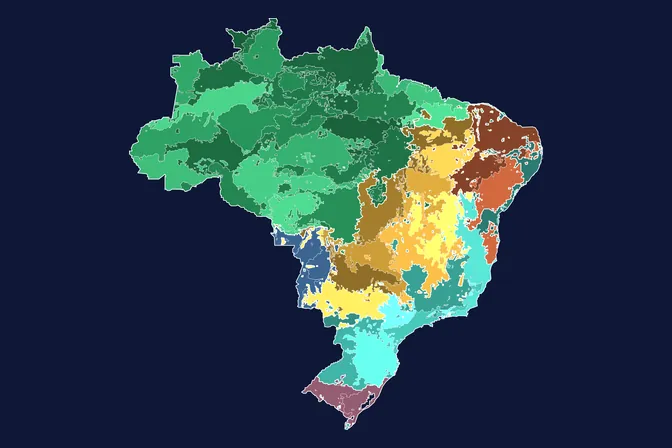
This map is a general picture and does not feed directly into the assessment of an area. To choose species, MORFO starts from the area's reference ecosystem and the supply of native seeds, two of the 21 criteria it combines. Seeds collected in the same climatic and ecological region as the area are more likely to adapt: the seed zones map shows those regions.
What MORFO does next
- Prescribes what to plant, at what density and with what soil preparation.
- Organises the seeds.
- Plants with our field partners.
- Measures the results over the years in MORFO Ri.
The data
Flora e Funga do Brasil (Rio de Janeiro Botanical Garden), native tree species by state. MORFO count and analysis. See the sources
MORFO scientific team · Version 1, updated November 2026
Related maps
How to cite
MORFO Data. Brazil resized by its number of native tree species. MORFO scientific team, version 1, November 14, 2026. Available at: https://www.morfo.rest/resources/data/tree-species-cartogram
CC BY 4.0 licence: reproduce with this citation and a link to the page. Source data keep the licence of each source.
Want this analysis for your area?
- Send your areaLocation, polygon or CAR number.
- Talk with the teamTo understand the project.
- Pre-analysis of the areaBlockers, operable area, site score and first methods.
MORFO Restoration Intelligence is the platform where each area's pre-analysis, plan and follow-up come together. See MORFO Ri
Your area
LET'S GROW with MORFO