What is the best method to restore a native forest?
Quentin Franque · 2026-11-28 · 10 minutes
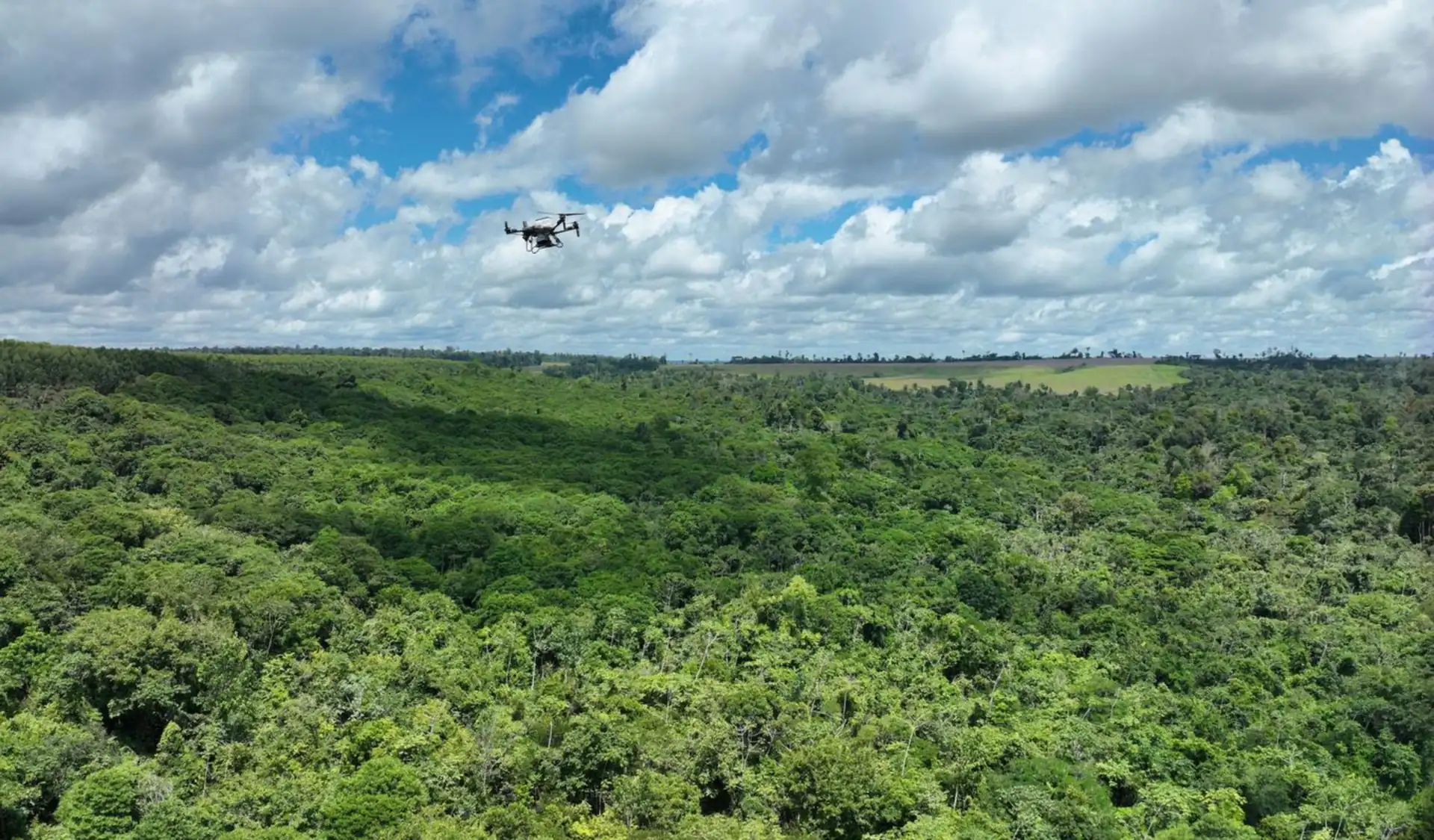
This page is for anyone who has to bring native forest back on degraded land, for a legal obligation, a carbon project or their own reasons, and is wondering which method to use: let it regrow, sow seeds, fly drones or plant seedlings.
The short answer: the best method is the cheapest one that works on each plot, and on most areas that means several methods at once. A method is ruled out only when something on the plot makes it fail, such as strong grass, a steep slope or no forest nearby. Among the methods that remain, the cheapest goes first. The harder part is not choosing. It is running different methods on different plots of the same area, with the seeds, seedlings, crews and calendar that each one needs.
The methods, from the cheapest to the most expensive
Native restoration in Brazil uses a small number of techniques. We rank them by cost, because cost is what decides between two methods that would both work.
| Method | What it is | Works when |
|---|---|---|
| Natural regeneration, left alone | No intervention, only monitoring | Dense regrowth is already there and seed sources are close |
| Natural regeneration, protected | Remove what blocks regrowth: fences against cattle, firebreaks | Regrowth is possible but held back by fire, cattle or logging |
| Natural regeneration, assisted | Help the young native plants survive: weed and control grass around them | Regrowth is there but fragile |
| Natural regeneration, enriched | Add seeds or seedlings in the gaps | Regrowth is there but too sparse or poor in species |
| Direct seeding | Sow a mix of native seeds, by hand, by machine (the muvuca) or by drone | Workable soil, grass that can be controlled, seeds available before the rains |
| Nucleation | Create dense patches by seeding or planting, with perches and brush piles to attract seed dispersers | Medium regrowth potential, forest close enough for the patches to spread |
| Seedling planting | Plant nursery-grown seedlings over the whole plot | Low regrowth potential, strong competition, or a need for speed and control |
Soil preparation is not a method but a layer under all of them. On degraded pasture it is almost always needed, and it is often the real cost item and the first cause of failure.
How the choice is made: rule out, then rank
The logic is a filter. A method is discarded only if something on the plot makes it unworkable: a slope too steep for machines, grass too strong for seeds, no forest close enough for regrowth. Among the methods left, the cheapest is recommended first. Cost orders the options. It does not remove them.
This happens in two steps. A remote pre-analysis reads the area from satellite and public data: land cover, distance to native forest, fire history, slope, estimated soil, access. It rules out what is clearly unworkable and ranks the rest. Then a field diagnostic, with drone and soil samples, measures what satellites cannot see: how many young native plants are already there, how strong the grass is, what the soil really contains. In several cases, it is the field that decides.
Before any method, a first check: whether part of the area cannot be worked at all, because it overlaps an Indigenous land, a strict protection area or an environmental embargo, or because it is an APP or Legal Reserve where existing native vegetation cannot be cut.
1. Is the forest already coming back on its own?
Start with what you might not need to do. On many degraded areas, part of the land is already regrowing: young native trees in the pasture, a forest edge advancing, seeds arriving from a fragment next door. Planting over that regrowth wastes money and can destroy it.
Distance to native forest is the first signal. In documented cases of natural regeneration in the Atlantic Forest, the distance between the source forest and the forest that grew back was about 1,000 metres on average (Dadalto et al., 2022, Espírito Santo restoration manual). That distance grows when the plot sits downhill from the forest and shrinks when a road, a wide river or a town stands in between. The quality of the neighbouring forest matters as much as the distance: pasture next to a rich fragment free of invasive species recovered best, while areas next to fragments poor in species recovered slowly (Bieras et al., 2015).
Fire history is the second signal. A plot that burns often can still regrow, but only once it is protected, so firebreaks and fire control come before anything else. Our article on natural regeneration in a Legal Reserve describes how regrowth is measured in the field.
Native vegetation grown back (2025)
Explore a location
2. What is holding the forest back?
Where the forest is not coming back, something is stopping it. Name it before choosing a method, because the method will fail if the barrier stays.
- Exotic grass, often Brachiaria. It is the most common barrier we meet. It shades and outcompetes young native plants and fuels fire. Its pressure decides whether direct seeding can work, and it does not show on satellite images: it has to be measured on the ground.
- Compacted or eroded soil. Seeds cannot root and water runs off. Soil preparation, or species that tolerate poor soil, come first.
- Fire and cattle. Fences and firebreaks can do more for a plot than any planting.
- Distance from seed sources. Far from any forest, nothing arrives on its own, so seeds or seedlings have to be brought in.
This is also where many restorations go wrong: the planting is done well, but the grass returns in the first rainy season and the young plants die. We describe that situation in native seedlings dying in an APP restoration.
3. Seeds or seedlings, and can they arrive in time?
Once the barrier is known, the choice between sowing and planting depends on the soil, the competition, the slope and the calendar.
Direct seeding puts many seeds of many species in the ground at once. It produces dense cover quickly where the soil can be worked and the grass controlled, and it costs less per hectare than seedlings because there is no nursery. It depends above all on a large volume of good native seed, available before the rains. Not every species establishes well from seed, which is why the species list is built for the method.
Seedlings give each plant a head start of several months. They tolerate competition better, let you place specific species exactly, and suit small or steep areas. They cost more per hectare and need more maintenance.
Slope changes the operation more than the method. Up to about 20 degrees, seeding and planting can be mechanised. Above that, the work is done by hand, which is slower and needs more people. Drones are a way to deliver seeds on plots that are steep, wet or hard to reach. They do not solve grass competition or poor soil, so they work on plots where seeding would work anyway.
In every case, the planting window decides more than the method. Seeds sown after the rains have settled, or seedlings delivered late, lose a large part of their season.
4. What will it cost here, and can the work be done here?
Two plots with the same ecology can call for different methods because the economics differ. These are the questions we ask on every area.
- How much of the area can be mechanised? Machines work up to about 20 degrees of slope. The share of the area above that sets how much has to be done by hand.
- How far are crews, seeds and seedlings? Half of Brazil's pasture land is less than 1.8 hours by road from a town of at least 50,000 people, but the median is 6.2 hours in Amazonas and half an hour in São Paulo. Every hour weighs on the cost of each planting trip and on how often maintenance can happen afterwards.
- Is there labour nearby? Assisted regeneration and seedling planting need many working days per hectare: weeding, planting, maintenance. Where few people work on farms, crews have to come from far away, and labour-light methods gain ground.
- What does the soil need? Correcting an acid or compacted soil can cost more than the method that follows. Where the soil is poor but the forest is close, regeneration avoids that cost.
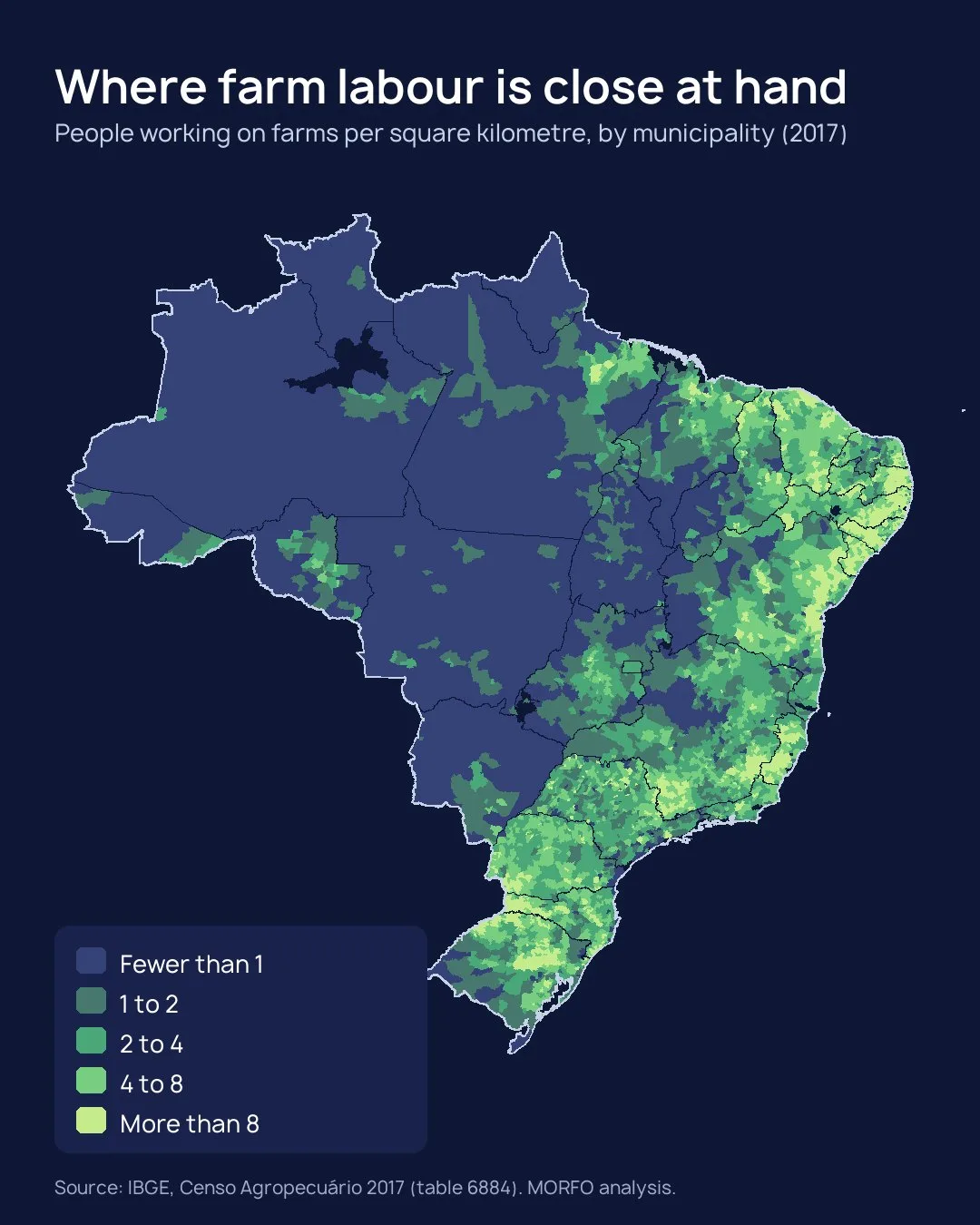
In 2017, 15.1 million people worked on Brazilian farms. In about one municipality in five, there were more than 8 per square kilometre. In about one in eight, fewer than 1. Source: IBGE, Censo Agropecuário 2017, table 6884, MORFO analysis.
5. What result is expected, and by when?
The same plot can call for different methods depending on what the restoration has to deliver.
- A legal obligation (Legal Reserve, APP, PRAD) is judged by the state agency on indicators such as vegetation cover and the density of native plants, within a deadline. The method has to reach those indicators on time.
- A carbon project is judged on biomass growth over decades, measured under a standard. Species that grow and store carbon well, and a high survival rate, weigh more.
- A biodiversity goal puts more weight on species richness and on threatened or local species, which often means seedlings for some of them.
What it takes to work plot by plot
Choosing a method per plot is the easy part on paper. Running several methods on the same area is where most of the work is, and it is the reason many restorations apply one method everywhere: not because it is the best for the land, but because it is simpler to run.
Working plot by plot means four things in practice.
- Reading each plot, not the area as a whole. The pre-analysis splits the area by land cover, slope, fire history and distance to forest. The field diagnostic then checks each plot for regrowth, grass and soil. A plot is a unit of decision, often a few hectares to a few dozen.
- Supplying several methods at once. Seeds for the direct seeding plots, seedlings for the planted ones, enrichment material for the regrowth, fencing and firebreaks for protection, all ready before the same rain window. Each has its own suppliers and lead times.
- Crews that can do different jobs on the same week. Mechanised seeding, manual planting, weeding around regrowth and building firebreaks are different skills and different equipment. Local operators do the work, coordinated on one calendar.
- Following each plot after planting. A method that does not take on a plot shows up in the first months if each plot is monitored separately. The correction is then local: replant, enrich, or switch the method on that plot only.
"We always start from the cheapest method the plot allows. Planting seedlings everywhere is easy to organise, but it pays for work the land did not need. The difficulty is having seeds, seedlings, fences and crews ready at the same time on plots that each need something different."
Hugo Asselin, director of operations, MORFO
On a real area, the result rarely looks like one method. A typical plan reads like this: a third of the area left to regrow behind fences and firebreaks, a block sown directly where the soil is flat and workable, seedlings along the stream where the grass is strongest, nucleation patches on a slope close to a forest fragment, and enrichment in an old regrowth patch that lacks species. Each choice has a reason that can be checked on the ground.
This is why the question "what is your method?" says less about a restoration company than "how do you choose the method on each plot, and can you run several at once?". We go through the other questions to ask in how to choose a native forest restoration company.
How MORFO chooses
We do not have a preferred method. We started with drone seeding, and we learned on the ground that it is the right answer on some plots and the wrong one on others. Today we choose the method plot by plot, with the filter described above: a pre-analysis that crosses satellite, climate, soil and economic data on the region, then a field diagnostic that confirms what the satellite cannot see.
Because we answer for the result and replant at our own cost if a plot fails, choosing the wrong method costs us money. That is the simplest reason we have to get the choice right.
Frequently asked questions
What is the cheapest way to restore a native forest? Where the forest is already coming back, protecting it (fences, firebreaks, grass control) costs the least per hectare. Elsewhere, direct seeding usually costs less than seedlings, because there is no nursery. The cheapest method on paper can cost more if it fails and has to be redone.
Is direct seeding better than planting seedlings? Neither is better in general. Direct seeding suits plots with workable soil, controllable grass and enough seed on time. Seedlings suit plots with strong competition or a need for specific species.
What is nucleation in forest restoration? It creates dense patches of native plants, by seeding or planting, often with perches and brush piles that attract birds and bats. The patches then spread. It works best within reach of a native forest: in documented Atlantic Forest cases, regrowth came from forest about 1,000 metres away on average.
Do drones work for forest restoration? Drones are a way to deliver seeds, useful on steep, wet or hard-to-reach plots. They work where seeding would work anyway, and they do not remove the need to control grass or prepare poor soil.
Why not use one method on the whole area? It is simpler to organise, but it pays for planting where the land would regrow on its own, and it fails where the method does not fit the plot. On most areas larger than a few dozen hectares, a mix of methods costs less per hectare of forest that actually grows.